Merokalam Tools
For many Nepalis, 19 Jestha 2058 BS needs little explanation. On the Gregorian calendar it was June 1, 2001. That evening, a monthly family gathering of Nepal's royal family at Narayanhiti Palace in Kathmandu ended in the deaths of King Birendra, Queen Aishwarya and eight other members of the royal family, in an event Nepalis generally call Durbar Hatyakanda (दरबार हत्याकाण्ड), the "palace killing incident."
This guide lays out what happened, when, where, who was involved, what the official investigation concluded, and why questions about that conclusion have never fully gone away. Where facts are disputed or unverified, that is stated plainly rather than presented as settled history.
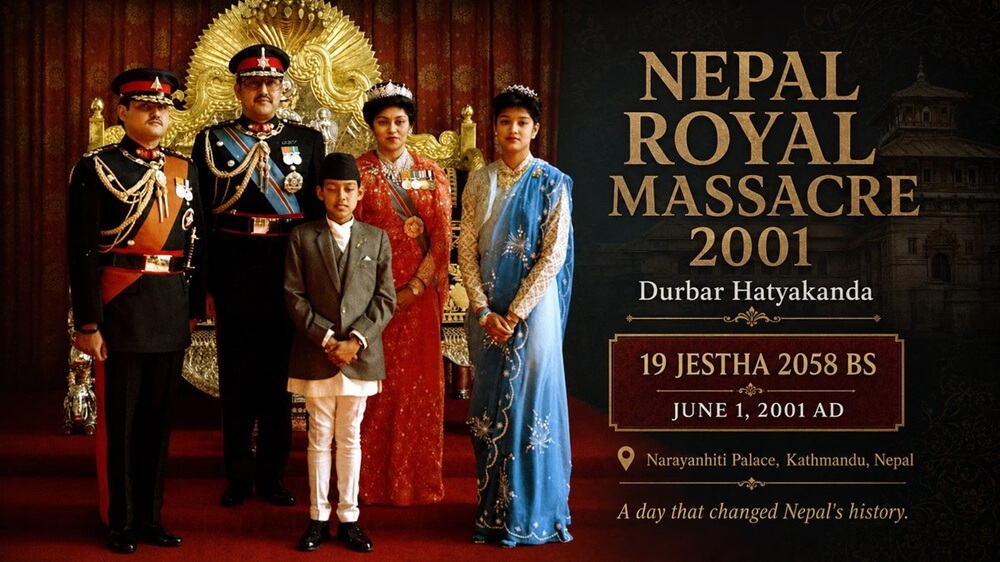
Nepal Royal Massacre at a Glance
| Detail | Information |
|---|---|
| Event | Nepal Royal Massacre / Durbar Hatyakanda |
| Nepali name | दरबार हत्याकाण्ड (Durbar Hatyakanda) |
| Nepali date | 19 Jestha 2058 BS |
| Gregorian date | June 1, 2001 (evening) |
| Location | Tribhuvan Sadan, Narayanhiti Palace complex, Kathmandu |
| King | King Birendra Bir Bikram Shah Dev |
| Queen | Queen Aishwarya Rajya Lakshmi Devi Shah |
| Total deaths | 10, including Crown Prince Dipendra |
| Official investigation | Concluded Crown Prince Dipendra was responsible |
| Successor | King Gyanendra, crowned June 4, 2001 |
Every detail above is cross-checked against multiple independent sources listed at the end of this guide.
What Was the Nepal Royal Massacre?
The Nepal Royal Massacre refers to the shooting deaths of nine members of Nepal's royal family on the evening of June 1, 2001, at Tribhuvan Sadan, a residential building inside the Narayanhiti Palace complex in central Kathmandu. The family had gathered, as they reportedly did on a monthly basis, for dinner. Within roughly fifteen minutes that evening, gunfire left King Birendra, Queen Aishwarya and seven other relatives dead or fatally wounded. Crown Prince Dipendra, identified by the subsequent official investigation as the person who opened fire, also died from a self-inflicted gunshot wound three days later, without ever regaining consciousness.
The event shocked Nepal for reasons beyond its scale. Birendra was not just a head of state; by 2001 he had spent over a decade as a constitutional monarch who had voluntarily ceded absolute power, and he was widely seen as a steady, restrained figure in a country going through serious political strain. His sudden, violent death, alongside most of his immediate family, left Nepal without a clear head of state for several tense days and triggered a rushed, still-debated succession.
This article establishes the documented record first: what is known, what the official inquiry found, and who was involved. Public doubts about that official account are real and are addressed later in this guide, but as doubts, not as an alternative set of facts.
Nepal Before June 1, 2001
To understand why the massacre mattered so much, it helps to know where Nepal stood in mid-2001. Nepal had been a Hindu constitutional monarchy since 1990, when a popular movement, the Jana Andolan, forced King Birendra to end decades of direct royal rule (the Panchayat system) and accept a multiparty democracy with the monarchy as a constitutional, largely ceremonial institution. Birendra's acceptance of that transition, rather than resisting it, was a significant part of why he was broadly respected.
At the same time, Nepal was five years into a Maoist insurgency that had begun in 1996 and was steadily spreading through the countryside, seeking to abolish the monarchy entirely and establish a communist republic. Birendra was known to be reluctant to deploy the Royal Nepal Army against the insurgents, preferring political negotiation, a position that put him at odds with some in the security establishment. The royal family, meanwhile, remained a highly visible, symbolically important institution in daily Nepali life, which is part of why the massacre felt less like a private family tragedy and more like a national one.
Who Was King Birendra?
King Birendra Bir Bikram Shah Dev ascended to Nepal's throne in 1972, following the death of his father, King Mahendra, and was formally crowned in 1975. Educated partly abroad, including time at Eton College and Harvard, Birendra ruled as an absolute monarch for the first two decades of his reign under the Panchayat system, before accepting constitutional, multiparty democracy after the 1990 people's movement.
As a constitutional monarch, Birendra was generally seen as measured and popular, staying above day-to-day politics while remaining a unifying national figure. He was married to Queen Aishwarya Rajya Lakshmi Devi Shah, and the couple had three children: Crown Prince Dipendra, Prince Nirajan and Princess Shruti. His sudden death, alongside his wife and two of his three children, removed not just a monarch but a family that much of the country had watched for nearly three decades.
What Happened on Jestha 19, 2058 BS?
The following sequence is built from the official investigation and multiple corroborating contemporary and retrospective accounts. Where sources differ on precise minute-by-minute detail, that is noted rather than smoothed over.
Members of the royal family assemble at Tribhuvan Sadan for what several accounts describe as a regular monthly family dinner. Crown Prince Dipendra is present and, according to the official investigation and multiple witness accounts, had been drinking and was described by some present as visibly unwell.
Accounts describe Dipendra being escorted out, reportedly after appearing unwell or acting erratically, and taken to his private quarters. He is separately reported to have spoken by phone that evening with Devyani Rana, the woman he wished to marry, a relationship his parents had opposed.
According to the official investigation, Dipendra returned to the gathering dressed in army fatigues and carrying more than one firearm, including an MP5 submachine gun, and opened fire on those present.
King Birendra, Queen Aishwarya and several other relatives were shot. Prince Dhirendra, Birendra's brother, was among those reportedly trying to intervene. The official investigation found the entire shooting lasted no more than about fifteen minutes.
Dipendra was found with a gunshot wound to the head and fell into a coma from which he never recovered. Surviving and wounded family members, along with the dead, were rushed to Birendra Military Hospital in Chhauni.
King Birendra's death was not officially announced until the afternoon of June 2. With the King dead and the Crown Prince comatose but technically next in line, Nepal entered an unprecedented several days of uncertainty over who its head of state actually was.
Who Died in the Nepal Royal Massacre?
Nine members of the royal family died from gunshot wounds sustained that evening, either immediately or within the following three days. Crown Prince Dipendra, identified by the official investigation as the person responsible for the shooting, also died three days later from a self-inflicted wound, bringing the total number of deaths connected to the massacre to ten.
Names and relationships above are cross-checked against multiple independent records. This guide lists factual relationships only and does not include graphic detail out of respect for those who died.
Who Survived the Nepal Royal Massacre?
A small number of royal family members present that evening were injured but survived, and one senior royal was not present at all.
Being absent from the dinner is a different fact from having been present and unharmed. This distinction matters and is treated carefully throughout this guide.
What Did the Official Investigation Conclude?
In the days after the massacre, Nepal's government formed a high-level, two-member probe committee, chaired by Chief Justice Keshav Prasad Upadhyaya and House Speaker Taranath Ranabhat. Over roughly a week, the committee interviewed more than 100 people, including surviving witnesses, palace staff and security personnel, and submitted a formal report in mid-June 2001.
According to the official investigation, Crown Prince Dipendra was solely responsible for the shootings. The report described him as heavily intoxicated that evening and pointed to his parents' opposition to his intended marriage to Devyani Rana as the most likely underlying motive, alongside broader personal strain. Because Dipendra never regained consciousness before his death, investigators could not question him directly, and the committee's conclusions rest on physical evidence and witness accounts rather than any statement from Dipendra himself.
Why Do Questions and Theories Still Exist?
Many Nepalis questioned the official explanation almost immediately, and that skepticism has persisted for over two decades. Understanding why matters more than repeating the theories themselves.
Several specific concerns are commonly raised. The investigating committee had only two members and a mandate of roughly one week, which critics argue was too limited for an event of this significance. A former Supreme Court registrar has pointed out that the committee's mandate was fact-finding rather than a formal judicial determination of guilt, meaning it lacked the legal authority to definitively assign criminal responsibility in the way a court would. No independent, third-party forensic review or autopsy findings were made public, and the bodies were cremated relatively quickly, in line with Hindu tradition but also removing the possibility of later independent examination. Gyanendra's absence that evening, while not evidence of anything on its own, has remained a persistent point of public curiosity. And for many people, the idea of Dipendra, described publicly as a composed, Eton-educated heir, carrying out a coordinated attack with multiple firearms while reportedly heavily intoxicated, has simply been hard to reconcile.
These are the reasons doubt exists, not evidence of an alternative explanation. Numerous specific theories have circulated since 2001, including claims involving other family members or foreign intelligence agencies. None of these alternative theories have been supported by verified evidence, and responsible reporting on this event treats them as unsubstantiated allegations rather than established fact. Some Maoist voices at the time framed the massacre as a political conspiracy, drawing comparisons to the 19th-century Kot Massacre, a historical palace bloodletting that reshaped Nepali politics, but this framing was political rhetoric rather than a documented finding.
As recently as June 2026, Nepal's Home Minister Sudhan Gurung indicated the government would review past investigation materials, a sign that questions around Durbar Hatyakanda have not fully settled even decades later.
What Many Nepalis Believe Really Happened
The official investigation has never been formally overturned, but it has also never fully closed the book for much of the Nepali public. More than two decades on, the massacre still generates heated debate, books and viral YouTube documentaries, which is not really the behavior of a population that has been convinced. Surveys measuring exactly how many Nepalis reject the official account do not exist, but journalists, analysts and academics who have revisited the case consistently describe the skepticism as widespread and durable rather than fringe.
What follows is a summary of the theories and suspicions that actually circulate among the public, not because any of them are established fact, but because a guide to this event would be incomplete without acknowledging what people believe alongside what was officially concluded. Each is presented as belief or allegation, clearly separated from the documented record above.
Three Kings in a Matter of Days
One of the massacre's most extraordinary and least understood consequences is that Nepal effectively had three different kings within the span of about four days.
Under Nepal's line of succession, Crown Prince Dipendra was next in line to the throne regardless of his medical condition, and he was formally proclaimed king on June 1 while still comatose, with his uncle Gyanendra named regent to act on his behalf. Dipendra never regained consciousness and died in the early hours of June 4. Later that same day, Gyanendra was proclaimed king, and his coronation took place alongside Dipendra's cremation. Gyanendra went on to become Nepal's last reigning monarch before the monarchy was abolished years later.
What Happened After the Massacre?
Nepal's government declared thirteen days of official mourning, in keeping with Hindu custom. Tens of thousands of people attended the funeral processions and cremations at Pashupatinath Temple in Kathmandu, and it was common to see men publicly shaving their heads as a mark of respect. Flags were lowered to half-mast, and access to radio and television was restricted for a period.
The transition was not calm. Protests broke out during Gyanendra's coronation on June 4, and police gunfire during the unrest reportedly killed six people. Hundreds of people, some suspected of being Maoist sympathizers, were arrested, and a curfew was declared in parts of Kathmandu. Internationally, condolences came from a wide range of governments and leaders, reflecting how closely Nepal's monarchy had been watched abroad.
It would be inaccurate to say the massacre alone ended Nepal's monarchy; the institution continued for several more years. But the massacre is widely seen as one of several major, destabilizing events in a turbulent period, alongside the ongoing Maoist insurgency and growing public dissatisfaction with Gyanendra's more assertive style of rule, that preceded Nepal's eventual transformation into a federal democratic republic in 2008, when the monarchy was formally abolished.
Why Jestha 19 Remains One of Nepal's Most Remembered Dates
More than two decades later, 19 Jestha is still widely recognized in Nepal, often described as a dark day in the country's modern history. Part of that is scale: the sudden loss of a king, queen and much of the immediate royal family in one evening has few parallels in recent world history. Part of it is the unresolved edge to the official story, which has kept the event in public conversation in a way that fully settled historical events rarely stay. And part of it is timing: the massacre landed in the middle of an already difficult period for Nepal, and for many people it marked a turning point after which the country's politics changed course.
Whatever a reader's view of the official investigation, the date itself, both in Bikram Sambat and Gregorian form, remains one of the most searched and referenced dates in modern Nepali history.
Understanding 19 Jestha 2058 BS and June 1, 2001 AD
Nepal officially uses the Bikram Sambat (BS) calendar, which runs roughly 56 to 57 years ahead of the Gregorian (AD) calendar and does not follow the same month lengths. That is why a single historical event, like the royal massacre, is almost always cited with two different dates depending on the source: Nepali newspapers, government notices and older documents typically use BS, while international reporting and most non-Nepali sources use the Gregorian date.
19 Jestha 2058 BS corresponds to June 1, 2001 AD. If you're researching other events from Nepal's history, comparing an old document or newspaper date, or simply trying to line up a Nepali date with what was happening internationally at the time, that BS-to-AD gap is exactly the kind of conversion a dedicated tool handles instantly rather than through manual calculation.
This article distinguishes findings of the official investigation from later allegations and public speculation. Historical details were checked against multiple independent sources, including Wikipedia's detailed record of the event, contemporary reporting archives and retrospective reporting from Nepali Times and Nepal News.
Frequently Asked Questions
Sources
| Topic | Source |
|---|---|
| Comprehensive event record, timeline, investigation, aftermath | Wikipedia: Nepalese royal massacre |
| Contemporary reporting on the investigation's findings | The Guardian, June 2001 |
| Public reaction and unrest following the massacre | The Guardian, June 2001 |
| Royal succession and political aftermath | Nepali Times |
| Investigation testimony and documentation | Nepali Times |
| Victim/survivor details and investigation report specifics | Nepal News |
| Public skepticism and calls for re-investigation | Nepal News |
| Public belief and alternative theories, including the "Rana Center" and foreign-involvement claims | Nepal News |
| Public sentiment a decade after the massacre | Inquirer.net (AFP) |
Published: August 2026. Last reviewed: August 2026. This is an independent explainer and is not affiliated with Nepal's government, royal family or any party referenced above. Where public doubts and theories are described, they are presented as unresolved public sentiment, not as verified fact.