Put the flags of twenty countries side by side and something becomes obvious almost immediately: nearly all of them are rectangles. A blue rectangle with stars, a red rectangle with a circle, three stripes inside a rectangle, over and over. Nepal's flag is not one of them. It is the only national flag in the world today that is not a quadrilateral at all, built from two stacked pennants instead of four straight sides.
That alone would make it an interesting outlier. What makes it a genuinely strange object is what happens next: Nepal's Constitution does not simply describe this flag in words. It tells you how to draw it, point by point, line by line, arc by arc, the way a geometry textbook walks you through a compass-and-straightedge construction. Somewhere between a national symbol and a proof, Nepal ended up with a flag whose legal definition is, quite literally, a set of construction instructions.
This is the story of why Nepal's flag looks the way it does: where the double-pennant shape came from, what every color and symbol is actually documented to mean (as opposed to what is simply repeated online), who is credited with turning it into a precise design, and how a national Constitution ended up functioning, in effect, like a geometry worksheet.
Nepal's flag is the world's only non-quadrilateral national flag: two crimson pennants stacked vertically, edged in deep blue, with a white crescent moon on the upper pennant and a white twelve-rayed sun on the lower one. Its shape is not just described but constitutionally constructed, through a step-by-step sequence of lines, perpendiculars, and arcs set out in Schedule 1 of the Constitution of Nepal. That construction produces a height-to-width ratio of roughly 1:1.219, an irrational number that cannot be written as a simple fraction, making Nepal's flag one of the only national flags in the world with a mathematically irrational shape.
Why Nepal's Flag Looks Different From Every Other National Flag
It helps to be precise about the distinction here, because most articles blur it. A square flag is technically not a rectangle in the everyday sense of "longer than it is tall," but a square is still a quadrilateral, a four-sided shape with four right angles. Switzerland's flag and Vatican City's flag are both squares, and both are still, geometrically, in the same family as every rectangular flag on Earth.
Nepal's flag is not in that family at all. Its outline is what the flag's Wikipedia description calls an irregular pentagon: two triangular pennants, stacked one above the other, sharing a single straight edge on the hoist (flagpole) side. Trace the outline with a finger, starting at the top of the pole: down the straight hoist edge, out to the point of the upper pennant, back in toward the pole at a small notch, out again to the point of the larger lower pennant, and back down to the bottom of the pole. Five straight sides, five corners. No other country flying a national flag today uses this kind of construction.
That is the more accurate and more interesting claim than the one most sites repeat. "The only non-rectangular flag" is true but undersells it. The precise version, "the only non-quadrilateral national flag," is the one that actually explains why Nepal's flag needs a geometric construction method at all: you cannot describe an irregular pentagon with a simple width-to-height ratio the way you can a rectangle. You need points, lines, and angles. Nepal's Constitution supplies exactly that.
Nepal Flag at a Glance
Before going any further into history or geometry, here is the flag broken into its six basic elements. The right-hand column becomes the rest of this article.
| Element | What it is | Why it matters |
|---|---|---|
| Overall shape | Two joined triangular pennants (an irregular pentagon) | Makes Nepal the world's only non-quadrilateral national flag |
| Main field | Crimson red | Nepal's national color, constitutionally specified |
| Border | Deep blue, uniform width on all sides | Frames the pennants and is itself part of the mathematical construction |
| Upper emblem | White crescent moon, eight rays visible of sixteen | Built from arcs and triangles inside the upper pennant |
| Lower emblem | White twelve-rayed sun | Built from two concentric circles inside the lower pennant |
| Construction | Fully geometric, defined step by step | Specified in Schedule 1 of the Constitution of Nepal, not just described in words |
This table separates what the flag physically is from why each part is significant. The sections below go through each row in depth, and are careful to separate officially documented meaning from popular interpretation, since the two get conflated constantly online.
The History Behind Nepal's Double-Pennant Flag
Nepal's flag was not invented in 1962. What happened in 1962 was standardization, the point where a design tradition that had existed for centuries, in various inconsistent forms, was finally given one exact, legally enforceable shape. The pennant itself is much older.
Early Pennant Traditions and the Shah Period
Triangular pennants, rather than rectangular banners, were a common battle and ceremonial standard across the Indian subcontinent and the Himalayan region for centuries before Nepal existed as a unified state. When King Prithvi Narayan Shah unified the many small principalities of the Kathmandu Valley and surrounding hill states into what became the Kingdom of Nepal in the mid-1700s, he is credited with bringing together the double-pennon idea that later became the national flag. Historical accounts describe the earlier Gorkha Kingdom flying a single triangular war banner, red, carrying various deities and symbols associated with the Shah rulers. The modern flag's two-pennant design is generally understood to combine visual traditions from both the Gorkha Kingdom's banner and the flag once used by the Mustang Kingdom, one contributing a pennant associated with the Shah dynasty's sun, the other a pennant associated with the historic moon symbolism of the region.
The Rana Period: When the Sun and Moon Had Human Faces
For a large part of its history, Nepal's flag looked noticeably different from the clean, faceless version flown today. Early depictions, including sketches by the British doctor and artist Henry Ambrose Oldfield from the mid-1800s, and a description in Percival Landon's 1928 book Nepal, which additionally records the flag's border as green rather than blue at that point, show both the sun and the moon carrying human faces.
According to historical accounts, it was Rana Prime Minister Jung Bahadur who added these faces, using them to symbolize the two ruling houses: the Shah kings as descendants of the lunar dynasty, represented by the moon's face, and the Rana family itself as descendants of the solar dynasty, represented by the sun's face. For roughly a century, the flag doubled as a piece of dynastic messaging as much as a national symbol, and ordinary depictions of it varied enough in shape and detail that "the Nepali flag" was more of a family of similar-looking pennant banners than one fixed design.
It is also worth noting, since it says something about how differently flags were treated at the time, that before the restoration of multiparty democracy in 1990, ordinary Nepali citizens were not permitted to fly the national flag at their own homes. Its use was tightly bound to government and royal authority rather than treated as an everyday expression of national identity, which is part of why standardizing its exact shape became a legal, not just decorative, priority.
1962: Standardizing a Flag People Kept Drawing Wrong
By the early 1960s, Nepal had a flag with a long pedigree but no single authoritative version. People drew it differently depending on which reference they copied, and the human faces on the sun and moon were seen as outdated for a modern nation-state's official symbol. King Mahendra's government moved to fix both problems at once: modernize the design by removing the faces, and lock down its exact shape so it could no longer drift from one drawing to the next.
That second part is the detail almost every casual retelling skips. The 1962 constitution did not simply publish a picture of the new flag. It devoted an entire section to the precise size and shape of the flag, spelling out the geometry because, in the government's own reasoning at the time, people were drawing the flag inaccurately. That decision, to legislate a construction method rather than just an image, is the single most distinctive fact about Nepal's flag and the one this article keeps coming back to.
Who Designed the Nepali Flag?
This distinction matters more than it first appears to. Saying "Rimal designed the Nepali flag" overstates his role, since the double-pennant shape, the crimson field, and the sun-and-moon motif all predate 1962 by a long stretch, rooted in the Shah and Rana-era banners described above. But saying he had nothing to do with it understates a genuinely important contribution: he is the person who worked out how to describe that inherited shape with enough mathematical precision that anyone, anywhere, following the same steps, would arrive at the identical outline.
Rimal was a civil engineer and architect by training, not primarily a flag designer, he also worked on notable Nepali structures including Shahid Gate and the Bhaleshwor Mahadev temple, and was involved in work on Narayanhiti Palace. His specific task in 1962 was translating an existing but inconsistently drawn national symbol into a repeatable geometric procedure. That procedure, not a new picture, is what got written into the constitution and is what every accurately drawn Nepali flag has followed since.
The clean way to hold both facts at once: the historical origin of Nepal's flag is a centuries-long evolution of Himalayan pennant traditions, unified under the Shah dynasty and later modified during the Rana period. The modern technical standardization of that flag, the version flown today, with its exact angles and proportions, has a specific author and a specific year.
What the Colors of Nepal's Flag Mean
Two colors, and only two: crimson for the body of both pennants, deep blue for the border that wraps around them. Both are constitutionally specified, but the depth of their symbolism is not equally well documented, and this is exactly where a lot of Nepal-flag content quietly slides from fact into folklore without telling the reader it happened.
Crimson Red
Crimson is consistently described, across government-adjacent and tourism sources, as representing the bravery of the Nepali people, a fairly standard association for a red field on a national flag, echoed on flags from many other countries. Nepal's crimson is also very commonly linked to the rhododendron, Rhododendron arboreum, locally called laligurans, which is Nepal's national flower and blooms in a deep red across the country's mid-hills each spring. The rhododendron connection is widely repeated and visually plausible, the color match is close, but it should be read as a popular and traditional association rather than a line item explicitly spelled out in the constitutional text itself, which specifies the color as crimson without walking through a botanical justification.
Deep Blue
The blue border is documented, again consistently across sources rather than in one single authoritative sentence in the constitution itself, as representing peace and harmony. It is worth noting that this border was not always blue: the 1928 written account by Percival Landon describes it as green at that point in the flag's history, which is a useful reminder that even elements treated as timeless today, like "the blue border," went through their own changes before 1962 fixed them permanently.
Simplified color-and-symbol breakdown. The moon and sun icons here are stylized for clarity; their real construction is covered in detail further down this article.
The Moon and Sun on Nepal's Flag
The two white emblems are the part most people can picture instantly and understand least. Both are more geometrically specific than they look, and both carry layered, sometimes competing, explanations for what they are supposed to represent.
The Moon: More Than Just a Crescent
The moon sits inside the upper, smaller pennant. Its shape is not a simple drawn crescent; the constitutional construction builds it from semicircles and arcs centered on specific reference points (discussed in full in the geometry section below), then fills the resulting crescent-shaped band with eight equal triangular rays, out of a full theoretical set of sixteen, alternating so that eight remain visible in the final emblem. It is white, matching the sun, against the crimson field.
What it is commonly understood to represent varies by source, and it is worth being upfront about that variation rather than picking one explanation and presenting it as settled: some accounts describe the moon and sun together as symbols of permanence and longevity, the idea that the nation will endure as long as the sun and moon exist. Others describe a geographic pairing, with the moon representing the cool climate of Nepal's Himalayan north and the sun the heat of the Terai lowlands to the south. Others still, including the CIA's World Factbook, connect the two emblems to Nepal's two major religious traditions, Hinduism and Buddhism. None of these is inscribed in the constitutional text itself, which specifies the moon's geometry but not a single official meaning, so all three are best treated as documented cultural interpretations rather than one government-sanctioned answer.
The Sun: Why Does It Have Rays?
The sun occupies the lower, larger pennant. Unlike the moon, there is no visibility fraction to account for, twelve rays is the full and final count, all pointing outward in an even radial pattern between two concentric circles whose radii are themselves derived from earlier points in the construction sequence. It is drawn white, the same as the moon.
Historically, before the 1962 standardization, the sun (like the moon) carried a human face, tied by Rana-era symbolism to the solar dynasty the Rana family claimed descent from. That face was removed in the modernization process, leaving the geometric rayed disc seen today. Its popularly cited meanings track the same three explanations already noted for the moon: permanence, geography (heat and the lowlands), or religious symbolism, again without a single official constitutional statement settling which one is "correct."
The Two Pennants and Their Meaning
This is the section where a genuinely popular claim needs to be handled with real care, because it is repeated constantly and rarely checked: that Nepal's two triangles represent Hinduism and Buddhism.
That specific claim shows up widely online, and versions of a religious reading do appear in at least one notable reference source for the celestial emblems (again, the World Factbook's Hinduism-and-Buddhism gloss on the sun and moon). But a direct, sourced statement that the two pennants themselves, as geometric shapes, were designed to represent the two religions specifically is not something this article was able to verify against the constitutional text or against primary historical accounts of the 1962 standardization. The more defensible account of the two pennants is a structural, historical one: two pennants because two separate flag traditions, roughly speaking the Gorkha Kingdom's banner and the Mustang Kingdom's flag, were combined into one when Nepal unified, not because someone sat down and assigned one triangle to each religion.
The honest position, and the one this article takes throughout, is to hold the two ideas apart rather than merge them: the sun-and-moon-as-religions reading has some documented backing at the level of popular and reference-source interpretation. The two-pennants-as-religions reading is a step further than the available sourcing supports. Treating both claims as equally solid would be the kind of unearned certainty this topic does not need.
The Part Most People Never Notice: Nepal's Flag Is a Math Problem
Here is a question worth sitting with for a second: if you wanted to draw Nepal's flag accurately, without tracing an existing picture, where would you even begin? A rectangle gives you an easy answer, pick a width, pick a height, done. Nepal's flag does not give you that shortcut, because there is no simple width-to-height ratio that defines an irregular pentagon. You need a method: a sequence of construction steps that starts from nothing and ends at the exact right shape, every time, for anyone who follows it.
That is exactly what Schedule 1 of Nepal's Constitution provides. Not a picture. Not a description in prose. A construction method, the same basic idea as a compass-and-straightedge proof in a geometry class: draw this line, find its midpoint, drop a perpendicular, mark where two lines cross, swing an arc from that point, and so on, until the final shape appears as the last, inevitable step of everything before it.
Not literally computer code, but conceptually identical to one: a fixed sequence where each step depends only on the results of the steps before it. Start here, measure this, draw this line, mark this point, construct this curve, repeat, until the finished flag falls out the other end.
The reference points in the real construction are not decorative letters. They are load-bearing: point C only exists because of point A and B, point H only exists because of A and B, and the moon's arcs only exist because of points that were themselves built from earlier points. Change any early measurement even slightly and every later step, and the final outline, shifts with it. That interdependence is exactly why casually "eyeballing" the flag from a photo, instead of following the actual construction, is so easy to get subtly wrong, and why the Constitution bothers spelling out the sequence at all.
How Nepal's Constitution Defines the Flag
What follows is an accessible, plain-language walk-through of the shape of that method, not a substitute for it. Schedule 1 itself is longer and more granular than any short article can usefully narrate in prose, with more intermediate points than are worth naming here. For anything that needs to be legally exact, a flag manufacturer's template, an official reproduction, a classroom exercise graded for precision, Schedule 1 itself, via the Nepal Law Commission, is the only authority that should be used.
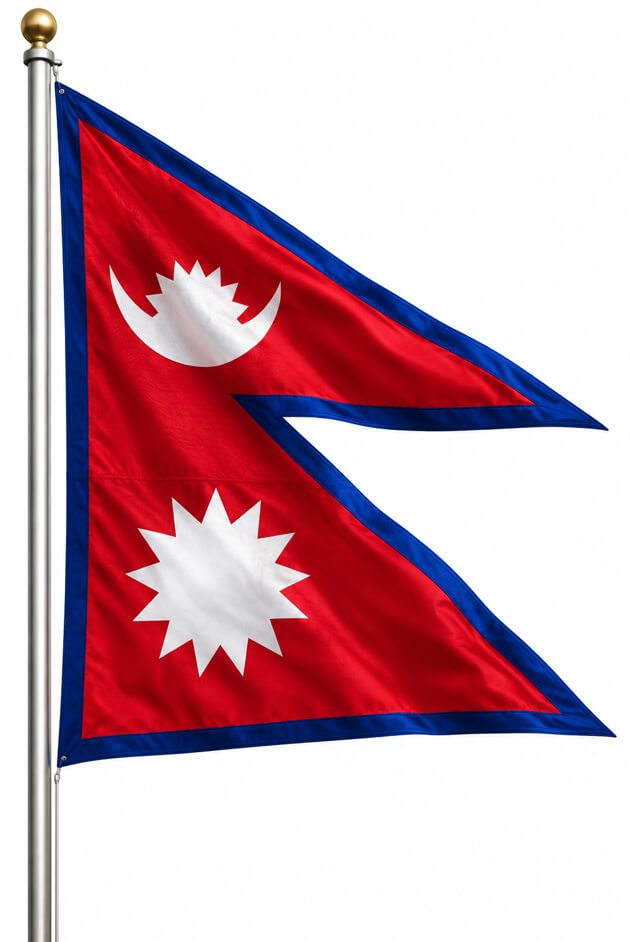
Nepal's actual flag: two crimson pennants stacked vertically and edged in deep blue, sharing one straight edge at the hoist (flagpole side). The smaller upper pennant carries a white crescent moon (eight of sixteen rays visible); the larger lower pennant carries a white twelve-rayed sun. Neither the tip angles, the small notch where the two pennants meet, nor the border width are drawn freehand, they are the output of the step-by-step construction set out in Schedule 1 of the Constitution, walked through below.
Understanding the Flag's Unusual Proportions
Most articles that mention a ratio for Nepal's flag round it down to something tidy, "roughly 4:3," and leave it there. That is not wrong as a rough approximation, but it skips the actual mathematical story, which is more interesting than a tidy fraction.
The crimson field by itself, the two pennants without any border, does have a clean rational ratio: 3 units wide to 4 units tall, exactly the 4:3 relationship set up in the construction's second step. If the flag ended there, "4:3" would be the complete and correct answer.
But the flag does not end there. The blue border, uniform in width, gets added around the outside of an irregular, five-sided shape, not a rectangle. Adding a uniform-width border to a non-rectangular outline changes the overall bounding box's proportions in a way that a simple fraction cannot capture, because the border's contribution to the total width and the total height depends on the specific angles of the pennants' slanted edges, not just their lengths. When mathematicians worked through the full construction algebraically, the result is a quartic equation, an equation whose highest power is four, and the flag's exact ratio is the smallest positive root of that equation: approximately 1.21901033782945218..., an irrational, non-repeating decimal. This value is catalogued in the Online Encyclopedia of Integer Sequences as sequence A230582, described there specifically as the height-to-width ratio of the bounding rectangle of Nepal's national flag as defined by its constitutional construction.
In plain terms: Nepal's flag is very likely the only national flag on Earth whose exact proportions are an irrational number rather than a clean ratio like 2:3 or 1:2. That is a genuinely unusual mathematical property for an object every Nepali citizen sees on a near-daily basis.
Ordinary rectangular flag
Ratio is a simple fraction, such as 2:3. Resize it and every edge scales together automatically.
Nepal's flag
Ratio is an irrational number derived from a quartic equation. The outline is five straight sides, not a simple box.
The Mathematics, in One Table
| Mathematical feature | What it does in the construction |
|---|---|
| Straight lines | Establish the initial reference geometry, starting from a single baseline |
| Perpendicular lines | Establish the vertical relationship that fixes the crimson field's 3:4 ratio |
| Bisected segments and parallels | Transfer measurements from earlier lines to new reference points without needing new independent measurements |
| Triangles | Create the two pennants, and the twelve rays of the sun and eight visible rays of the moon |
| Circles and arcs | Construct the crescent moon and the sun's two concentric rings |
| Uniform-width border | Added last, around the full irregular outline, producing the final irrational overall ratio |
Every figure in this table and the preceding section is traceable either to Schedule 1's construction method directly, or to the OEIS-catalogued numerical derivation of that construction (sequence A230582). No dimension here has been invented for effect.
Nepal's Flag Compared With Other National Flags
The point of comparing flags here is not to build a small encyclopedia of world flags. It is to answer one specific question: exactly how far outside the norm does Nepal's shape sit?
| Country | General outer shape | Distinctive feature |
|---|---|---|
| Nepal | Irregular pentagon (double pennant), non-quadrilateral | Two stacked pennants; only irrational-ratio national flag |
| Switzerland | Square (still a quadrilateral) | White cross on red |
| Vatican City | Square (still a quadrilateral) | Two vertical fields plus coat of arms |
| United States | Rectangle | Stars and stripes |
| Japan | Rectangle | Red disc, centered |
| Bangladesh | Rectangle | Red disc, offset toward the hoist |
The distinction that actually matters, repeated here because it is the single most misreported fact about this flag online, is non-quadrilateral versus merely non-rectangular. Switzerland and Vatican City break the "rectangle" assumption but not the "four sides" assumption. Nepal breaks both.
Why Didn't Nepal Use a Rectangle?
There is no single, clean, documented reason Nepal specifically rejected a rectangular flag, and this article is not going to invent one. What the historical record supports is a story of preservation rather than deliberate rejection: Nepal already had a centuries-old pennant tradition, tied to the Gorkha and Mustang kingdoms, by the time rectangular flags became the global default for nation-states in the 19th and 20th centuries. Standardizing that existing pennant shape in 1962, rather than replacing it with a rectangle to match international convention, kept an already-established visual identity intact instead of discarding it for the sake of uniformity. That is a reasonable, historically grounded account. Framing it any more strongly, such as claiming Nepal actively "refused" rectangles as a statement, goes beyond what the historical record actually documents.
Why the Shape Is Important Today
An unusual constitutional shape is not just a historical curiosity. It creates ongoing, practical friction almost every time the flag needs to appear somewhere designed with rectangles in mind, which, in the modern world, is most places.
Printing and manufacturing templates, digital flag icon sets, country-code emoji-style flag graphics, online flag databases, and even merchandise all default to rectangular canvases. Nepal's flag routinely gets squeezed, stretched, or placed on a white rectangular background to fit software and hardware built around a four-sided assumption, which is exactly the kind of careless handling that produces the distorted, slightly-wrong versions seen occasionally in print and online.
The clearest real-world example of this friction played out on the Olympic stage. Olympic ceremony protocol traditionally called for every competing nation's flag to be a rectangle at a standard 2:3 ratio, for visual uniformity across the parade of nations. Nepal's flag does not fit that mold, and for years the practical workaround, seen as recently as the 2016 Rio Olympics, was printing Nepal's flag onto a white rectangular backing so it could still be mounted like every other country's flag. That changed at the 2020 Tokyo Olympics, when Nepal reportedly became the only exception to the standard flag-size requirement, with organizers instead matching Nepal's flag to the height of other nations' flags rather than forcing it into the same rectangular footprint.
The flag's precision requirements have also caused visible controversy domestically. In 2018, during a visit to Janakpur by Indian Prime Minister Narendra Modi, a flag flown with an incorrect shape, including a noticeably thicker blue border than specified, drew public criticism precisely because the error was so easy for ordinary Nepalis to spot. Ted Kaye, secretary of the North American Vexillological Association, has described Nepal's flag in blunt terms that capture why: "It's the nerdiest mathematical flag that is out there." Getting it slightly wrong is unusually easy, and unusually noticeable, for exactly that reason.
How to Draw the Nepal Flag Correctly
There is a real gap between three different levels of "knowing how to draw Nepal's flag," and being clear about which level you are working at avoids a common mistake: treating a simplified sketch as if it were legally exact.
Beginner version: understand the overall structure first. Two triangular pennants stacked vertically, sharing a straight hoist edge, a small notch where the upper pennant's lower edge meets the lower pennant's upper edge, a crescent moon in the upper pennant, a twelve-rayed sun in the lower one, and a blue border around the whole outline. Getting this structure right, even freehand, avoids the single most common error: drawing a rectangle with a triangle cut out of it, which is not the same shape as Nepal's flag at all.
Accurate version: once the structure is understood, tracing a downloaded image is not a reliable path to an accurate flag, because compressed, resized, or already-slightly-wrong reference images propagate their own errors. A ruler-and-compass approach, following the actual sequence of construction steps rather than eyeballing proportions from a picture, produces a genuinely accurate result the same way following a geometry proof produces a genuinely correct answer.
Constitutional version: for any use where legal exactness matters, official reproductions, government publications, manufacturing templates, the only authoritative source is Schedule 1 of the Constitution of Nepal itself, via the Nepal Law Commission. A simplified summary, including the one in this article, is a teaching aid for understanding the shape of the method. It is not a substitute for the legal text when precision is actually required.
Common Mistakes When Drawing the Nepal Flag
Drawing a rectangle with a triangular notch cut from one side, instead of two genuinely separate pennants sharing a hoist edge.
Two distinct triangular pennants, one smaller (moon) above one larger (sun), joined only along the straight hoist edge.
Making the blue border too thick or too thin relative to the pennants, the exact error criticized in the 2018 Janakpur incident.
Border width is fixed by the construction itself (derived from the moon-construction measurement), not chosen freehand.
Giving the moon or sun the wrong ray count, or spacing rays unevenly.
Exactly eight visible moon rays (of sixteen) and exactly twelve evenly spaced sun rays.
Stretching or squashing a downloaded image to fit a rectangular template or slide layout.
Preserve the flag's own bounding-box ratio; if a rectangular frame is unavoidable, pad around the flag rather than distorting it.
Placing the moon or sun too high, too low, or off-center within their pennants.
Both emblems sit at fixed positions derived directly from the construction's reference points, not by eye.
Using a bright or orange-leaning red instead of true crimson, or a bright royal blue instead of deep blue.
Crimson field, deep (navy-leaning) blue border, as specified.
You Probably Never Noticed This
A few details about the flag tend to survive even a fairly close look, simply because nobody goes looking for them:
Official Fact vs. Popular Interpretation
This table exists because so much online content about Nepal's flag blurs the line between what is documented and what is repeated. Being explicit about that line is, frankly, more useful than another paragraph of confident-sounding trivia.
| Claim | Status |
|---|---|
| The flag's shape and construction are set out in the Constitution (Schedule 1) | Official, verified against the constitutional text |
| The moon shows eight of sixteen rays; the sun has twelve rays | Official, verified against the constitutional construction |
| The overall ratio is irrational, approximately 1:1.219 | Verified via independent mathematical derivation (OEIS A230582) |
| Crimson represents bravery; blue represents peace | Widely and consistently documented, but not quoted verbatim from the constitutional text itself |
| Red is linked to the rhododendron, Nepal's national flower | Popular and traditional association, not a constitutional statement |
| Sun and moon represent Hinduism and Buddhism | One documented reference-source interpretation among several competing ones, not a single settled official meaning |
| The two triangles/pennants specifically represent Hinduism and Buddhism | Could not be verified against primary sources; more likely explained by the historical merger of two separate pennant traditions |
| Before 1962, the sun and moon had human faces | Documented in historical accounts and imagery predating the 1962 standardization |
Nepal's Flag Through Modern History
What is genuinely notable about this flag is not any single event in its past, but how much political upheaval it has quietly sat through unchanged. The same double-pennant shape flew over the Shah monarchy, through the Rana period's dynastic reworking of its symbols, past the 1962 standardization under King Mahendra, through the People's Movement that restored multiparty democracy in 1990, through Nepal's decade-long insurgency, past the monarchy's abolition in 2008 when Nepal became a federal republic, and into the 2015 Constitution that carries the same Schedule 1 construction forward under Article 8 today.
That continuity was not automatic. In May 2008, around the time the monarchy was abolished, various political parties raised the question of whether the flag's design, tied as it was to monarchical and Hindu symbolism in the popular imagination, should change along with the state's political structure. The proposal to alter the flag was ultimately rejected, and the same pennant shape that flew over the kingdom kept flying over the republic. What changed, in other words, was almost everything about how Nepal governed itself. What did not change was the shape of the cloth flown above it.
Flag Facts Worth Knowing
Frequently Asked Questions
Final Thoughts
What first looks like a simple red flag with two points turns out to hold centuries of history, layered and sometimes contested symbolism, and a genuinely sophisticated piece of geometry, all folded into one small piece of cloth. Nepal did not stumble into a strange-looking flag by accident. It preserved a distinctive visual tradition through unification, dynastic change, and modernization, and then, in 1962, took the unusual step of defining that tradition's exact shape as a mathematical construction inside its own constitution.
That last part is what makes this flag worth a second look, and a third. Most countries chose a rectangle and moved on. Nepal kept its double pennant, wrote down exactly how to build it, and ended up with a national symbol whose precise proportions are, provably, irrational. Few flags reward a closer look with an actual geometry lesson. This one does.