What Is Typeshala Online?
Typeshala is Merokalam's free, browser-based typing tutor for learning and practising Preeti, Nepali Unicode and English QWERTY. It runs guided lessons through a 10-stage path for each layout, plus timed tests with live Net WPM and accuracy tracking. There is no account, login or download required, just a browser and a keyboard.
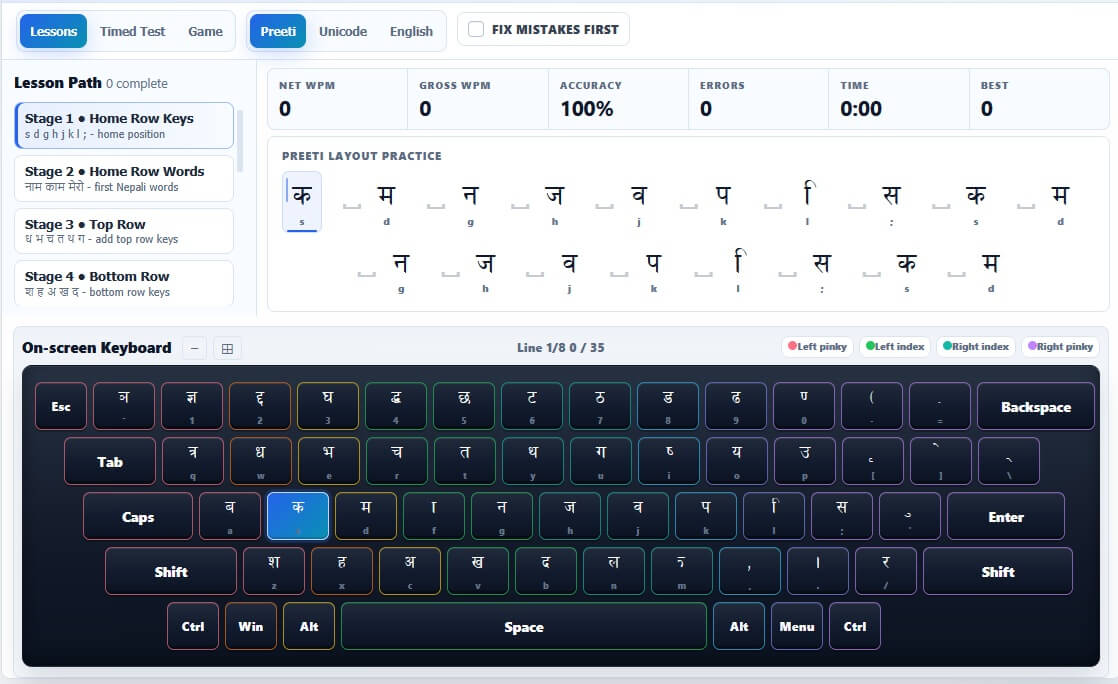
If you've never opened Typeshala before, here's the short version: click into the practice box, choose Preeti, Unicode or English, and start typing whatever character is highlighted. Everything else on this page, modes, lessons, WPM, accuracy, is just detail on top of that one action.
Which Typeshala Typing Mode Should You Use?
Typeshala offers three separate practice tracks. Pick based on what you'll actually type, not which one sounds more "modern."
Preeti
- Learning the legacy Preeti keyboard
- Older office and document workflows
- Typing-job preparation where Preeti is required
- Working with existing Preeti documents
Nepali Unicode
- Modern Nepali typing for the web
- Websites, apps and digital documents
- Modern office work
- Romanized-to-Devanagari input
English
- Standard QWERTY keyboard practice
- General office and data-entry skills
- Overall typing speed and accuracy
- Computer skill test preparation

Not sure which one applies to you? Preeti stays relevant for older office files and some typing-job requirements, Unicode is the default for anything you'll publish, share or type into a modern form, and English is worth a separate pass if your work or exam also tests standard keyboard skills.
How to Start Typeshala in 30 Seconds
How Typeshala Lessons Work
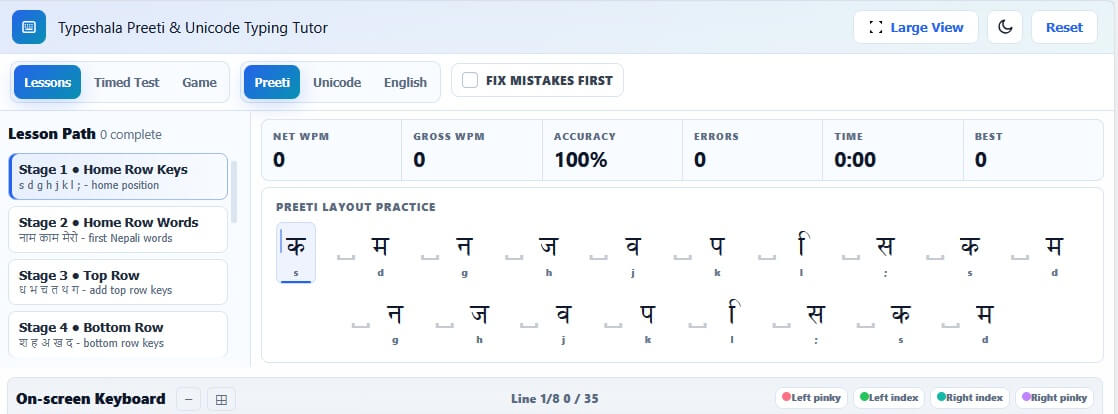
Each layout, Preeti, Unicode and English, runs through the same progressive 10-stage lesson path. Early stages isolate a small group of keys; later stages combine rows, vowel marks, half forms and full sentences. Skipping straight to sentences is where most beginners get stuck.
| Stage | Lesson focus | What you practise | Target before moving on |
|---|---|---|---|
| 1 | Home Row Keys | Core home-row finger positions | Comfortable finger placement |
| 2 | Home Row Words | First short words from the keys you just learned | Slow but clean word typing |
| 3 | Top Row | Top row keys and row transitions | Less looking down at the keyboard |
| 4 | Bottom Row | Bottom row keys and lower-key movement | Stable full-keyboard reach |
| 5 | Vowel Marks | Matra combinations (Preeti and Unicode) | Matra accuracy |
| 6 | Half Forms | Halant-style joint-letter combinations | Conjunct confidence |
| 7–8 | Sentences | Short, common sentence patterns | Rhythm with punctuation |
| 9 | Lok Sewa Short | Formal short sentences | Exam-style accuracy |
| 10 | Advanced | Longer, mixed-difficulty lines | Timed-test readiness |
Below the lesson list sits a Fix Mistakes First toggle. Turn it on when you're building accuracy: it stops the lesson from letting you skip past a wrong keystroke, which trains cleaner habits before you chase speed.
Typeshala for Beginners: Where Should You Start?
The goal here is to stop you from randomly clicking around the tool.
WPM and Accuracy: What the Numbers Actually Mean
What does WPM mean in Typeshala?
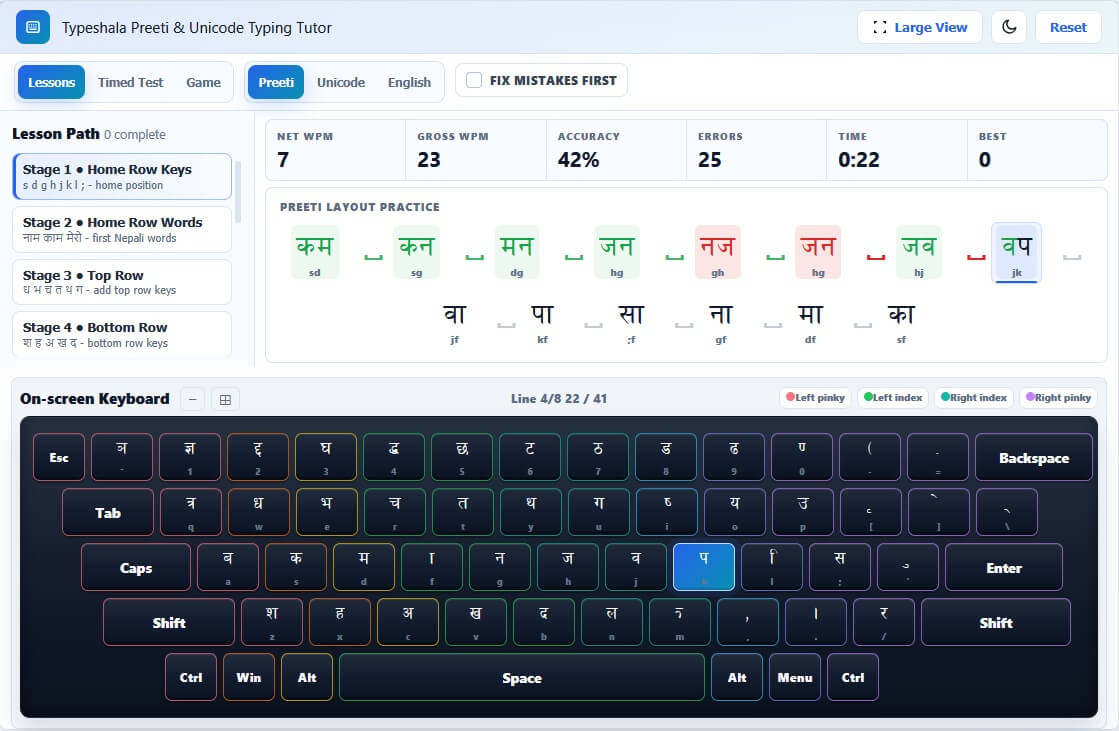
WPM stands for Words Per Minute. Typeshala shows two versions side by side: Gross WPM and Net WPM. Gross WPM is your raw keystroke speed. Net WPM is the stricter, more honest number, because it subtracts your uncorrected errors.
If your Gross WPM is much higher than your Net WPM, you're typing fast but losing marks to mistakes. That gap is the number to actually watch, not the Gross WPM by itself. 25 WPM at 98% accuracy is usually better practice than 35 WPM full of mistakes, because the first one is closer to your real, usable typing speed.
What does typing accuracy mean?
Accuracy is correct attempts divided by total attempts. Type 100 characters with 5 wrong, and you're at roughly 95% accuracy. Typeshala uses this live, so you can see exactly when a stage is going well or when you should slow down.
| Accuracy | What it means |
|---|---|
| 98–100% | Excellent, move ahead |
| 95–97% | Good, repeat once |
| 90–94% | Slow down |
| Below 90% | Restart the stage |
What Is a Good Nepali Typing Speed?
These bands are Merokalam's own practice benchmarks from inside Typeshala, based on Net WPM, not a universal exam standard.
| Net WPM | Level | What it usually means |
|---|---|---|
| 10–19 | Beginner | Still learning key positions, looking down often |
| 20–29 | Basic use | Can type simple words, speed drops on matras and punctuation |
| 30–39 | Functional practice | Good enough for many daily tasks if accuracy stays stable |
| 40–54 | Comfortable office | Handles longer passages without fighting the keyboard |
| 55+ | Advanced | Strong rhythm, fewer pauses between words |
These are practice benchmarks, not universal employment or Lok Sewa requirements. If a specific exam or job states its own typing requirement, treat that as the number that actually matters and verify it from the official notice.
Don't Try to Type Fast on Day One
The realistic progression looks like this: key recognition, then accuracy, then words, then sentences, then speed, then timed tests. Trying to jump straight to speed just trains bad finger paths that are harder to unlearn later.
7-Day Typeshala Starter Plan
A recommended session length is 15–30 minutes a day. This is a practical suggestion, not a scientific guarantee of results.
30-Day Nepali Typing Challenge
How to Practice Preeti Typing With Typeshala
- Select Preeti mode.
- Learn the physical key positions rather than memorising sounds.
- Avoid looking constantly at the physical keyboard; use the on-screen hint instead.
- Repeat difficult combinations, especially half forms in Stage 6.
- Move on to words once single keys feel automatic.
- Run a timed test once a stage feels comfortable.
- Track Net WPM and accuracy across sessions, not just one lucky run.
Start Preeti Typing Practice →
If you already type Preeti but need it installed for offline documents, see Preeti Font Download. Typeshala teaches the keyboard; the font page covers what your computer needs to display and print existing Preeti files correctly.
Should You Learn Preeti or Unicode?
Preeti and Unicode both produce Nepali text, but they solve different problems. Preeti is tied to a specific font and older key mappings. Unicode is a text standard that works across modern devices and websites.
| Goal | Recommended |
|---|---|
| Modern web typing | Unicode |
| Online forms | Unicode |
| Modern documents | Unicode |
| Existing old Preeti files | Preeti knowledge useful |
| Legacy office workflow | Preeti may be useful |
| General modern Nepali writing | Unicode |
Preeti is not useless, and Unicode and Preeti aren't simply "two fonts", they're different text systems with different tooling around them. If you deal with old Preeti files regularly, keep the Preeti to Unicode Converter bookmarked alongside Typeshala.
Do You Need a Font, or Do You Need Typeshala?
These solve two different problems, and mixing them up is a common beginner confusion: a keyboard skill lets you type Nepali; a font lets your computer display Nepali text correctly, especially older Preeti files.
Need Preeti on your computer?
Typeshala teaches you the Preeti keyboard. If you also need the actual Preeti font installed to open or print existing Preeti-based documents outside the browser, see Preeti Font Download.
Need Nepali Unicode fonts?
Unicode text usually displays fine without installing anything extra, but for design work or specific document styling, see the Nepali Font Download Guide for a shortlist of reliable Unicode Devanagari fonts.
How to Learn Nepali Unicode Typing With Typeshala
Unicode matters because it's the text standard behind websites, apps, email and most government portals today. In Typeshala's Unicode mode, you type Nepali sounds using English letters, for example typing namaste-style Romanized input produces Devanagari output. Start with Stage 1 vowels, move to consonants, then common words, then simple sentences. For the complete key-by-key layout reference, see the Nepali Unicode Keyboard Layout guide.
How to Practice क्ष, त्र, ज्ञ and Joint Letters
Joint letters (sanyukta akshar) show up constantly in real Nepali text, and Stage 6 in Typeshala is built specifically around them:
क्ष त्र ज्ञ श्र प्र क्र
Typeshala gives you the repetition to build muscle memory for these combinations. For the underlying halant rule and how each conjunct is actually built, see How to Type Nepali Joint Letters, then come back to Stage 6 to practise it.
What If You Just Need to Write Nepali Quickly?
Not everyone wants formal keyboard training, and that's fine. Typeshala teaches you to type; Easy Nepali Typing lets you write Nepali right now using Romanized English, no lessons required.
mero naam ram ho → मेरो नाम राम हो
Already Have an Old Preeti Document?
Typeshala teaches and practises typing; it doesn't touch existing files. If you have old Preeti-based text that needs to become standard Unicode, that's a conversion job, not a typing job.
Which Merokalam Tool Do I Need?
| You want to… | Use |
|---|---|
| Learn Nepali typing | Typeshala |
| Improve typing speed | Typeshala |
| Test your WPM | Typeshala |
| Type Nepali using English letters, right now | Easy Nepali Typing |
| Convert old Preeti text | Preeti to Unicode |
| Prepare Unicode for a Preeti workflow | Unicode to Preeti |
| Download the Preeti font | Preeti Font Download |
| Find Unicode Nepali fonts | Nepali Font Guide |
| Learn the keyboard layout | Unicode Keyboard Guide |
| Learn joint letters | Joint Letter Guide |
How to Use the Typeshala Typing Test
Timed tests are available in 1, 3 and 5-minute durations, plus a Game mode for lighter, extra practice.
- Switch to the Timed Test tab.
- Choose a duration and mode.
- Type naturally, don't obsessively correct every mistake on your first attempt.
- Let the timer run out.
- Review Net WPM, Gross WPM, accuracy and errors.
- Repeat, and compare against your Best score.
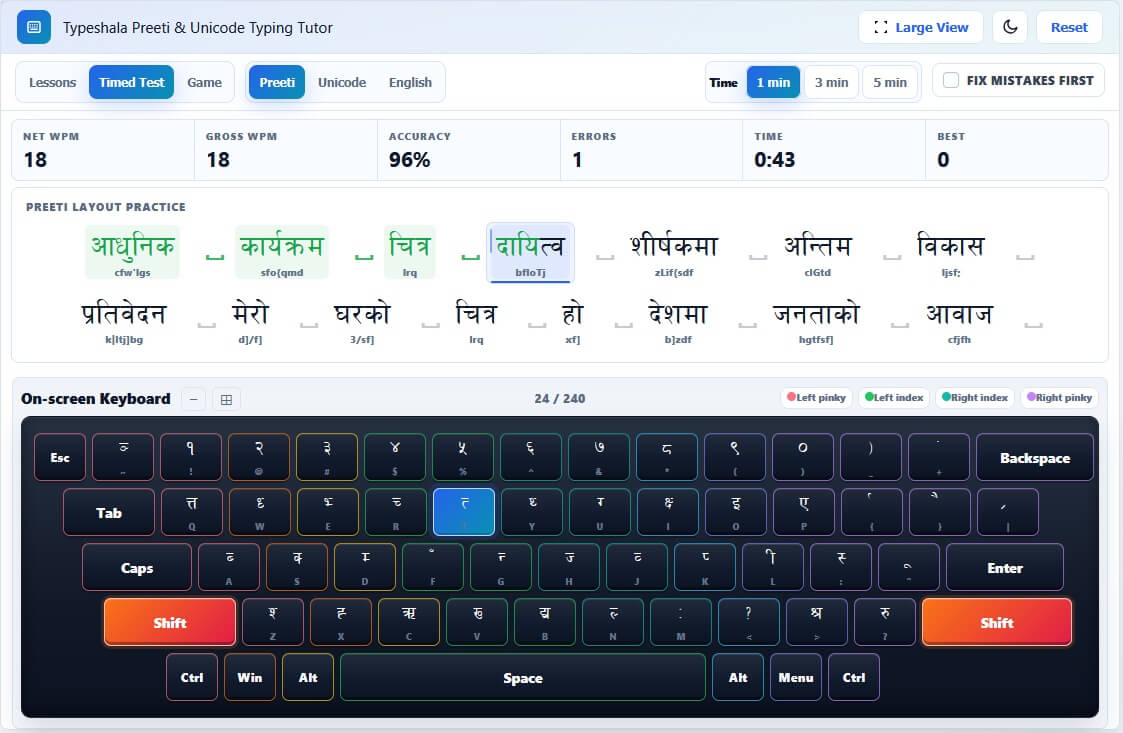
Illustrative example, not guaranteed results. The improvement that matters isn't just +4 WPM, it's that accuracy climbed too, which is what actually makes the higher speed usable.
Typeshala Not Working? Common Fixes
Check you're on the right layout (Preeti, Unicode or English) for the lesson you're doing. Each layout maps the same physical keys differently.
Click directly into the practice box first so the page has focus, then start typing on a physical keyboard.
Net WPM subtracts uncorrected errors, so a few mistakes can pull the number down more than it feels like it should. Check Gross WPM alongside it for the raw-speed comparison.
The page opens fine on mobile, but real practice needs a physical or Bluetooth keyboard. Touchscreen typing won't train the same finger memory.
Progress is saved in your browser's localStorage, not an account. Clearing browser data or switching devices or browsers resets it.
Unicode mode expects Romanized input; typing Preeti-style keys into Unicode mode (or vice versa) produces the wrong characters. Confirm the active layout button first.
Can You Use Typeshala on Windows, Mac and Mobile?
Since Typeshala runs in the browser rather than as installed software, it works the same way across Windows 10, Windows 11 and Mac, with no installer or driver compatibility to worry about. Merokalam has a dedicated guide with more detail on this if you're switching from an old desktop typing program.
See Typeshala Windows & Mac Guide →
Can you use Typeshala on a phone?
The page opens on mobile browsers and the lesson path and stats stay visible, but a physical keyboard is genuinely better for learning real finger positions. Typeshala shows a direct notice about this on small screens rather than pretending mobile typing is equal to keyboard practice.
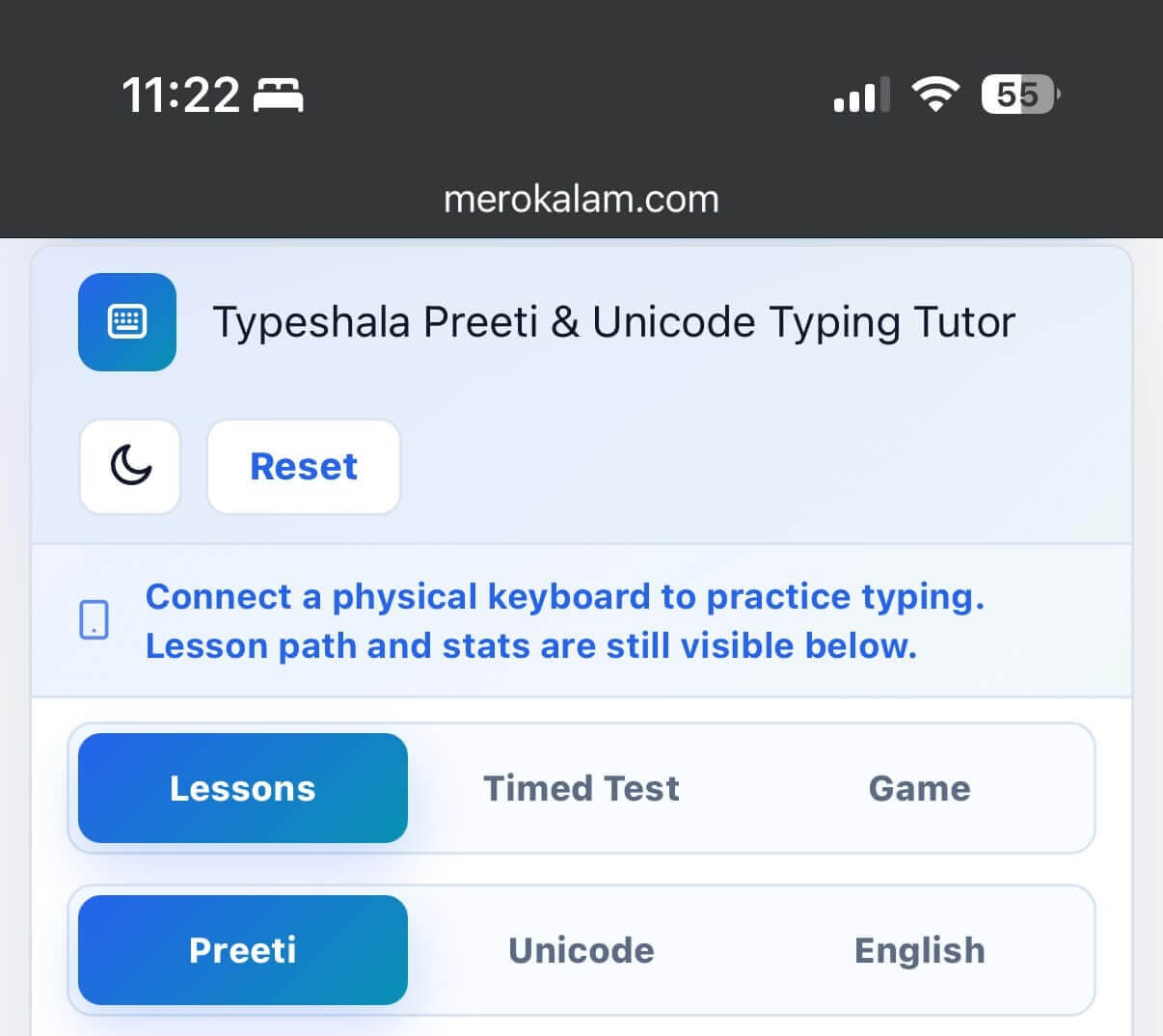
For dedicated mobile input without a physical keyboard, see Nepali Typing on Mobile: Android & iPhone Guide.
Does Typeshala Give a Certificate?
Not currently. Typeshala tracks practice progress, such as your best WPM and completed lessons, in your browser's localStorage, but it does not issue a completion certificate at this time. Treat Typeshala as a practice and skill-building tool rather than a credential: it is not a government-accredited qualification, a Lok Sewa certification, or an employer certification.
Can You Use Typeshala for Lok Sewa Typing Practice?
Typeshala can help you build keyboard familiarity, Preeti or Unicode accuracy, general speed, and timed-test confidence, all genuinely useful for Lok Sewa preparation. That said, official keyboard requirements, WPM thresholds, format and exam rules depend entirely on the specific Public Service Commission syllabus and post.
This is an independent practice tool and is not an official Lok Sewa Aayog website or examination platform. Confirm current requirements from the relevant vacancy or examination notice.
Can Typeshala Help With Office Job Typing?
Office roles built around Preeti legacy work, Unicode documents or general English typing all benefit from the same fundamentals: comfortable key positions, steady accuracy, and a WPM you can rely on under time pressure. Typeshala's lessons and timed tests build exactly that.
Nepali Typing for Office Jobs: Preeti, Unicode & WPM Skills →
Finished the Lessons? What to Practice Next
Once the 10-stage path and timed tests feel comfortable, the next step is more real-world words and sentences rather than more isolated key drills.
Nepali Typing Practice for Beginners walks through a longer practice roadmap with real content, and How to Increase Nepali Typing Speed in Preeti is the next stop if Preeti speed specifically is your goal. The loop that works best: learn in Typeshala, practise with real sentences, come back to the timed test to measure progress.
How We Prepared This Guide
We tested Typeshala's Preeti, Unicode and English modes directly, worked through Stage 1 lessons in each layout, switched between Timed Test durations, checked the live Net WPM, Gross WPM, accuracy and error tracking, and reviewed how the tool behaves on a mobile browser before writing this guide. Every screenshot on this page is from that same testing session, not a mockup.
Keep Building on This
More Nepali Typing Tools & Guides
Once Typeshala's lessons feel comfortable, these cover everything around them in more depth.
This guide explains how to use Merokalam's own Typeshala tool. Practice benchmarks reflect Typeshala's internal tracking, not universal employment, exam or Lok Sewa Aayog standards; always confirm official requirements from the relevant notice.