If you've ever looked at a page of Nepali text and felt the letters blur into one unfamiliar block, you're not alone. Most guides make it worse by handing you a wall of characters to memorize, अ आ इ ई first, then क ख ग घ, with no explanation of how any of it fits together. That's not how the Nepali alphabet actually works, and it's not how anyone actually learns it, whether they're a five-year-old in a Kathmandu classroom or a fifty-year-old NRN in London trying to read a message from their grandmother.
Nepali writing is built on a small, logical system: a set of consonant sounds, a set of vowel sounds, and a set of rules for combining them into syllables. Learn the system once, and every word in the language becomes readable, because the same handful of rules repeat everywhere. This guide walks through that system from the ground up, using one consonant, क (ka), as a running example, and ends by showing you exactly how to type every letter you learn, using tools built for this on Merokalam.
The Nepali Alphabet at a Glance
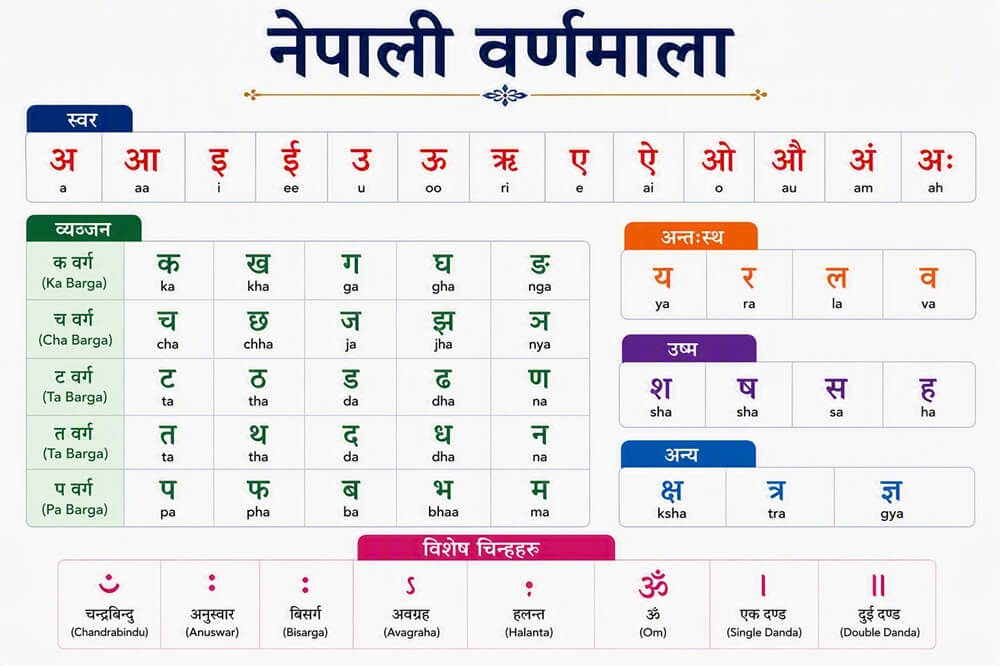
Before going section by section, here's the whole system on one screen. Everything below this chart gets explained in detail, but if you just need a quick reference to come back to, bookmark this part or save the image.
What Is Nepali Barnamala?
वर्णमाला (barnamala) is made of two Nepali words: वर्ण (barna), meaning "letter" or "sound," and माला (mala), meaning "garland" or "string." Put together, barnamala literally means "a garland of letters," which is a genuinely nice way to think about an alphabet: not a random pile of symbols, but sounds strung together in a fixed, learnable order.
Nepali is written in the Devanagari script, the same script used for Hindi, Marathi, Sanskrit, and several other South Asian languages. This is where a lot of confusion starts, so it's worth being precise: Devanagari is the writing system, the actual shapes of the letters. The Nepali alphabet is how that writing system is organized and used specifically for the Nepali language, its own set of sounds, its own conventions, and in a few small places its own letters and usage that differ from how Hindi uses the same script. Nepali and Hindi share almost the entire letter set and you can read one script if you know the other, but "Nepali alphabet" and "Devanagari alphabet" are not exactly interchangeable terms, in the same way "the Latin alphabet" and "the English alphabet" aren't quite the same thing even though English is written with Latin letters.
Barnamala splits into two families: स्वर (swar), the vowels, and व्यञ्जन (byanjan), the consonants. Every syllable in Nepali is built from a consonant sound and a vowel sound joined together, and once you understand that joining process, you can sound out words you've never seen before. That's the entire goal of this guide.
The Vowels: स्वर
Nepali has 11 independent vowels. They're called "independent" because each one can stand completely on its own, with no consonant attached, as its own letter and its own sound.
| Vowel | Roman | Sounds roughly like | Example word |
|---|---|---|---|
| अ | a | "a" in "sofa" | अनार (anaar, pomegranate) |
| आ | aa | "a" in "father" | आमा (aama, mother) |
| इ | i | "i" in "bit" | इमान्दार (imaandaar, honest) |
| ई | ii | "ee" in "feet" | ईश्वर (iishwar, god) |
| उ | u | "u" in "put" | उनी (uni, he/she) |
| ऊ | uu | "oo" in "boot" | ऊन (oon, wool) |
| ऋ | ri | a rolled "ri" | ऋषि (rishi, sage) |
| ए | e | "e" in "bed", held a bit longer | एक (ek, one) |
| ऐ | ai | "ai" in "aisle" | ऐना (aina, mirror) |
| ओ | o | "o" in "go" | ओखर (okhar, walnut) |
| औ | au | "ow" in "cow" | औषधी (aushadhi, medicine) |
Two vowels are worth flagging early because you'll see them constantly. ऋ is genuinely rare outside words borrowed from Sanskrit, so don't worry about producing its sound perfectly, focus on recognizing it. And अ deserves special attention, because it behaves differently from the other ten. Every consonant in Nepali already carries an "a" sound built in by default, which is exactly why the next section matters so much.
Vowel Signs (Matras): How क Becomes 14 Different Syllables
This is the part that actually unlocks reading Nepali, so slow down here even if you skim the rest.
Write a bare consonant like क on its own and it isn't silent, it already says "ka." That built-in "a" sound is called the inherent vowel. If you want क to make a different vowel sound, say "ki" instead of "ka," you don't swap in the independent vowel इ. Instead you attach a small mark called a मात्रा (matra) to the consonant. Ten of the eleven vowels have a matra form; अ doesn't need one, because it's already there by default.
Watch what happens to a single consonant, क, as different matras attach to it:
One consonant, fourteen distinct syllables, and every single one is built from the same base letter plus a small, predictable mark. This is exactly the same process every other consonant goes through. Swap क for म and you get मा मि मी मु मू मृ मे मै मो मौ मं मः मँ. Swap it for न and you get ना नि नी नु नू नृ ने नै नो नौ नं नः नँ. Learn this one pattern and you've effectively learned how to build syllables out of all 33-plus consonants at once.
There's one quirk that trips up almost every new learner: ि (the "i" matra). It's the only matra that gets written before the consonant it belongs to, but it's still pronounced after it. So कि is written क-then-ि from left to right, but read as "ki," consonant sound first, vowel sound second, exactly like every other matra. Your eye sees the vowel mark first; your mouth still says the consonant first. This isn't a mistake in the script, it's just a visual convention that Devanagari has always had, and it becomes automatic with a little practice.
The Consonants: व्यञ्जन
Nepali organizes most of its consonants into five neat groups of five, called वर्ग (barga, meaning "group" or "class"). Each barga is named after its first letter, and each one moves the point of contact in your mouth a little further back or forward. After the five bargas come two smaller groups that don't fit the barga pattern: four semivowels and four sibilants.
क-वर्ग: The Velar Group
Produced at the back of the mouth, near the soft palate. Examples: कलम (kalam, pen), घर (ghar, house), and रङ (rang, color), where ङ shows up, since it almost never opens a native Nepali word but appears often at the end of one.
च-वर्ग: The Palatal Group
Produced with the tongue near the roof of the mouth, further forward than the क-वर्ग. Examples: चिया (chiya, tea), छाता (chhata, umbrella), जुत्ता (jutta, shoes). ञ is the rarest letter on this entire chart in independent use; you'll mostly meet it inside the conjunct ज्ञ or in a handful of words like पञ्च (pancha, five, in formal usage).
ट-वर्ग: The Retroflex Group
Made by curling the tip of the tongue back against the roof of the mouth. Examples: टोपी (Topi, cap), डाक्टर (Daaktar, doctor), ढोका (Dhoka, door). ण almost always shows up in the middle of Sanskrit-origin words such as गणित (ganit, mathematics), rarely at the very start of a word.
त-वर्ग: The Dental Group
Made with the tongue touching just behind the upper front teeth. Examples: तारा (taara, star), दिन (din, day), नाम (naam, name).
प-वर्ग: The Labial Group
Made using the lips. Examples: पानी (paani, water), फूल (phool, flower), मन (man, mind/heart).
अन्तस्थ: Semivowels
अन्तस्थ means roughly "standing in between," because these four sit acoustically between full consonants and vowels. Examples: याक (yaak, yak), रुख (rukh, tree), लुगा (luga, clothes), वन (van, forest).
ऊष्म: Sibilants
ऊष्म means "heat" or "friction," describing how these sounds are produced with a continuous rush of air. Examples: शहर (shahar, city), सुन्दर (sundar, beautiful), हात (haat, hand). ष is the least common of the three "sh"-ish letters in everyday spelling; you'll meet it mostly in words like भाषा (bhaasha, language).
Aspirated vs. Unaspirated Consonants
Look back at any barga and you'll notice a pattern: the letters come in pairs, one "plain" and one with a puff of extra breath. That puff is called aspiration, and Nepali treats it as a completely separate sound from its unaspirated twin, not just a stylistic variation.
Try this quick test: hold the back of your hand right in front of your mouth and say "pa" the way you would in English. You'll feel almost no air. Now say फ (pha) and push a real breath of air out with it, you should feel a distinct puff hit your hand. That difference in airflow is the entire distinction between प and फ, and it's the same difference between every unaspirated/aspirated pair above. It feels subtle at first, but Nepali speakers hear it as clearly as English speakers hear the difference between "b" and "p."
Dental vs. Retroflex Consonants
The second pattern that catches new learners off guard is the difference between the त-वर्ग (dental) and ट-वर्ग (retroflex) groups, because to an English-trained ear they can sound almost identical at first.
त थ द ध न: tongue tip touches just behind the upper front teeth. Softer, flatter sound.
ट ठ ड ढ ण: tongue tip curls up and back against the roof of the mouth. Sharper, more "clicked" sound.
Say तारा (taara, star) and टमाटर (Tamaatar, tomato) out loud a few times, paying attention to where your tongue lands on the very first sound. That physical difference is the whole story, no amount of listening will replace physically noticing where your tongue is.
Special Signs
Beyond the vowels, consonants, and matras, Nepali uses a handful of extra marks that change or shape how a syllable sounds, plus two punctuation marks unique to Devanagari.
| Sign | Name | What it does | Example |
|---|---|---|---|
| ं | अनुस्वार (anusvara) | Adds a light nasal sound after the vowel | संसार (sansaar, world) |
| ँ | चन्द्रबिन्दु (candrabindu) | Nasalizes the vowel itself, through the nose | साँझ (saanjh, evening) |
| ः | विसर्ग (visarga) | Adds a light breathy "h" after the vowel | दुःख (dukha, sorrow) |
| ् | हलन्त / विराम (halant) | Cancels a consonant's inherent "a" sound; the glue that builds conjuncts | भगवान् (bhagwaan) |
| । | पूर्ण विराम (danda) | Marks the end of a sentence, like a period | नमस्ते। |
| ॥ | दोहोरो दण्ड (double danda) | Marks the end of a verse, hymn, or formal passage | ॥ शुभम् ॥ |
Conjunct Letters: संयुक्ताक्षर
Sometimes two (or occasionally three) consonants fuse into a single combined glyph, with no vowel sound between them. That fused shape is called a संयुक्ताक्षर (sanyuktakshar), a conjunct. This is where the halant sign from the table above earns its keep: a conjunct is really just consonant + halant + consonant, visually merged.
क्ष is क + ष, त्र is त + र, ज्ञ is ज + ञ. These three are common enough, and old enough in the tradition, that many textbooks list them alongside the 33 base consonants and describe Nepali as having "36 consonants" as a result. That's a useful shorthand, but it's worth being precise about what's actually happening: क्ष, त्र, and ज्ञ are not separate base letters with their own independent identity the way क or त are. They're specific, frequently used combinations of letters you already know, written as a single fused shape for convenience. The rest of the conjuncts above work exactly the same way, and there's no fixed, official list of "all Nepali conjuncts," because in principle almost any two consonants can combine this way when a word calls for it.
Nepali Alphabet vs. English Alphabet
People often ask how many letters Nepali has compared to English's 26, expecting a tidy answer. There isn't one, and that's fine, because the two writing systems aren't built on the same idea of what a "letter" is.
So rather than a single "X vs Y" number, the honest comparison is structural: English strings sounds left to right as separate letters, Nepali builds syllables by combining a base consonant with a vowel mark, and the second approach is genuinely more efficient once it clicks.
Pronunciation Guide
The Roman spellings used throughout this guide are practical approximations, not a strict linguistic transcription. They're meant to get you close enough to be understood and to recognize sounds, not to replace hearing a native speaker. Nepali has several sounds, aspiration and the dental/retroflex distinction especially, that simply don't have a clean one-letter English equivalent.
| Nepali | Roman (approximate) | Example word |
|---|---|---|
| क | ka | कलम (pen) |
| ख | kha | खुशी (happiness) |
| छ | chha | छाता (umbrella) |
| ठ | Tha | ठूलो (big) |
| ध | dha | धन्यवाद (thank you) |
| भ | bha | भात (rice) |
| श | sha | शहर (city) |
| ऋ | ri | ऋषि (sage) |
If a Romanized spelling in any tool, keyboard, or website ever looks slightly different from what's shown here, that's expected. Romanization is a convenience, not a standard with one fixed spec, so you'll see small variations everywhere, "chha" vs "cha," "Da" vs "dda," and so on.
Learn Through Words
Letters in isolation only mean so much. Here are a few everyday words that lean on patterns from this guide, so you can watch the system working in something you'd actually say:
How to Type Nepali Letters
Knowing the alphabet and being able to produce it on a keyboard used to be two very different skills, because most keyboards, physical and on-screen, don't have Devanagari keys. The easiest bridge between them is Romanized typing: you type the word the way it sounds using your normal English keyboard, and a converter turns it into correct Nepali Unicode text in real time.
This is exactly what Type Nepali online with Romanized typing does: you type phonetically, using letters and sounds you already know, and it converts your input into properly formed Nepali Unicode text, matras, conjuncts, anusvara and all, applied automatically according to the same rules you just learned in this guide. It works for full sentences, not just single words, so you can type a message, an essay, or a social media post the same way.
Nepali Keyboard Layout
Romanized typing is the fastest way to start, but if you want to type more like a native Nepali keyboard user, or you're using a physical Devanagari keyboard, it helps to understand how a dedicated Nepali keyboard layout maps keys to letters, rather than mapping keys to sounds.
A Nepali keyboard layout assigns each Devanagari letter, vowel, matra, and sign to a specific physical key, arranged for touch-typing speed rather than for matching English sounds. That's a different mental model from Romanized typing, and it takes more memorization up front, but it's usually faster once you're fluent with it. If you want to see and practice the actual key positions, explore the Nepali keyboard layout to find where every letter from this guide actually sits.
Preeti vs. Unicode: What's the Difference?
If you've spent any time around Nepali typing, especially older documents, government forms, or news sites, you've probably run into the word "Preeti." It's important to understand that Preeti and Unicode are not two versions of the same thing; they're fundamentally different concepts, and confusing them is one of the most common typing headaches in Nepali computing.
| Preeti | Unicode Nepali | |
|---|---|---|
| What it is | A font that remaps English keyboard keys to Devanagari-looking glyphs | A universal standard where each Nepali character has its own permanent code point |
| Portability | Only displays correctly where the exact Preeti font is installed | Displays correctly on any modern device, browser, or app, no special font needed |
| Searchable/copyable text | No, it's really Latin characters wearing a Devanagari costume | Yes, it's real Nepali text that search engines and screen readers understand |
| Where you'll still see it | Legacy documents, some older government and print workflows | Websites, social media, messaging apps, modern word processors |
In plain terms: a Preeti file looks like Nepali only because a specific font is tricking your screen. Copy that same text into a place without the Preeti font installed and it turns into gibberish, random Latin letters and symbols, because underneath the display layer, it never was actual Nepali text. Unicode Nepali, by contrast, is the real thing: the character क is stored as the character क everywhere, permanently, regardless of font. For anything you're typing today, for the web, for messaging, for documents you want to keep working in the future, Unicode is the right choice, and it's what a Romanized typing tool like Merokalam's produces automatically.
Practice Typing What You've Learned
Reading about letters and actually producing them fluently are two different skills, and the second one only comes from repetition. Once the alphabet in this guide starts to feel familiar, the fastest way to make it stick is structured typing practice rather than more reading.
Build real typing speed and muscle memory with guided lessons that walk through the exact letters, matras, and conjuncts covered in this guide.
Practice Nepali typing in TypeshalaYour Next Step
There's a natural order to actually getting good at this, and it's worth following in sequence rather than jumping around.
Common Mistakes to Avoid
Treating इ and ई as interchangeable, e.g. writing दिन (din, day) when you mean दीन (deen, poor/humble).
Length matters: short इ vs. long ई changes the word entirely. Practice both matras separately.
Blending उ and ऊ, e.g. rushing "u" and "uu" into the same short sound.
ऊ is held noticeably longer than उ. Say उनी and ऊन side by side to feel the gap.
Not distinguishing dental त/द/न from retroflex ट/ड/ण.
Dental sounds are made with the tongue near the teeth; retroflex sounds curl the tongue back. See the dedicated section above.
Writing इ in the wrong visual position out of habit from other matras.
ि goes before the consonant visually, but is read after it. It's the one exception, not the rule.
Assuming every conjunct like क्ष or ज्ञ is its own standalone base letter you need to memorize separately from scratch.
Conjuncts are combinations of letters you already know, fused together. Learn the base letters first, and most conjuncts become recognizable, not new.
Confusing anusvara (ं) with candrabindu (ँ), or dropping them entirely when typing.
Anusvara adds a nasal sound after the vowel; candrabindu nasalizes the vowel itself. Both change meaning, so don't skip them.
Expecting one single, universal Romanization spelling for every Nepali word.
Romanized spelling is a flexible approximation, not a fixed standard. Small spelling variations across sources are normal and expected.
Assuming Preeti text can be copy-pasted anywhere and will still look correct.
Preeti only displays correctly with the exact matching font installed. For anything you want to last, type in Unicode instead.
Can You Read This? Mini Quiz
Try sounding each of these out before revealing the answer. Start with Beginner, and only move on once it feels comfortable.
घर
नेपाल
किताब
नमस्ते
विद्यालय
धन्यवाद
स्वतन्त्र
प्रश्न
प्राकृतिक
संस्कृति
विश्वविद्यालय
प्रविधि
Can You Type This?
Once reading feels solid, try producing these using Romanized typing. Type the phonetic spelling and compare what comes out against the Nepali shown here.
30-Second Vocabulary: Everyday Practice Words
| Nepali | Romanized | Meaning |
|---|---|---|
| नमस्ते | namaste | hello / greetings |
| धन्यवाद | dhanyabad | thank you |
| माफ गर्नुहोस् | maaf garnuhos | sorry / excuse me |
| आमा | aama | mother |
| बुबा | buba | father |
| दिदी | didi | older sister |
| दाई | dai | older brother |
| बहिनी | bahini | younger sister |
| भाई | bhai | younger brother |
| विद्यालय | vidyaalaya | school |
| किताब | kitaab | book |
| कलम | kalam | pen |
| शिक्षक | shikshak | teacher |
| विद्यार्थी | vidyaarthi | student |
| भात | bhaat | cooked rice |
| दाल | daal | lentils |
| पानी | paani | water |
| चिया | chiya | tea |
| फल | phal | fruit |
| सागसब्जी | saagsabji | vegetables |
| घर | ghar | house |
| सडक | sadak | road |
| पसल | pasal | shop |
| शहर | shahar | city |
| गाउँ | gaun | village |
| जाने | jaane | to go |
| आउने | aaune | to come |
| खाने | khaane | to eat |
| पढ्ने | padhne | to read/study |
| सिक्ने | sikne | to learn |
| राम्रो | raamro | good |
| नराम्रो | naraamro | bad |
| धेरै | dherai | a lot / very |
| थोरै | thorai | a little |
Frequently Asked Questions
The stable core is 11 vowels and 33 consonants. Depending on whether a source counts anusvara/visarga as additional vowels, or counts common conjuncts like क्ष, त्र, ज्ञ as extra consonants, you'll see totals reported anywhere from around 46 to 49. Both approaches are legitimate; there's no single official count everyone agrees on.
They use the same Devanagari script and share nearly all of the same letters, so someone who reads one can read most of the other. But Nepali and Hindi are different languages with different vocabularies, grammar, and some differences in everyday spelling and usage conventions.
Not exactly. Devanagari is the script, the shapes of the letters, shared by several languages including Nepali, Hindi, Marathi, and Sanskrit. The "Nepali alphabet" refers to how that script is organized and used specifically for the sounds and conventions of Nepali.
Barnamala (वर्णमाला) literally means "garland of letters." It's the Nepali word for the alphabet as a whole, vowels and consonants together.
A matra is a small vowel sign attached to a consonant to change its built-in "a" sound to a different vowel sound, for example क + ि = कि. Ten of Nepali's eleven vowels have a matra form.
It's a long-standing visual convention of the Devanagari script, not an error or an exception you need to "fix" as you learn. Your eye reads ि first, left to right, but your mouth still produces the consonant sound first, exactly as with every other matra.
स्वर (swar) are the 11 vowels, sounds that can stand alone. व्यञ्जन (byanjan) are the consonants, sounds that need a vowel attached, either the inherent "a" or a matra, to form a complete syllable.
क-वर्ग, च-वर्ग, ट-वर्ग, त-वर्ग, and प-वर्ग, five groups of five consonants each, organized by where in the mouth the sound is produced, moving from the back of the throat to the lips.
Aspiration is an extra puff of breath released with certain consonants, like ख, घ, छ, झ, ठ, ढ, थ, ध, फ, भ. It's a distinct sound in Nepali, not decoration, so क and ख are genuinely different letters, not variations of the same one.
त (and the rest of त-वर्ग) is dental, made with the tongue near the upper teeth. ट (and ट-वर्ग) is retroflex, made by curling the tongue back against the roof of the mouth. They're distinct sounds that change word meaning.
Anusvara (ं) is a mark placed above a letter that adds a light nasal sound after the vowel, as in संसार (sansaar, world).
Visarga (ः) adds a light breathy "h" sound after the vowel, as in दुःख (dukha, sorrow).
No. Conjuncts are combinations of consonants you already know, fused into one shape. क्ष, त्र, and ज्ञ are commonly taught alongside the base consonants because they're old and frequent, but structurally they're combinations, not standalone letters with their own separate identity.
English has 26 letters, but the two alphabets aren't directly comparable because they're built on different systems: English is purely alphabetic, while Nepali is alphasyllabic, with vowels attaching to consonants rather than standing as separate equal-sized letters.
The easiest way is Romanized typing: type the word phonetically using English letters, and a converter tool turns it into correct Nepali Unicode automatically. Merokalam's Nepali typing tool works exactly this way.
Preeti is a font that remaps English keys to Devanagari-looking shapes; it only displays correctly wherever that exact font is installed, and the underlying text isn't really Nepali. Unicode Nepali stores each character permanently and correctly, so it displays properly everywhere, is searchable, and is copy-paste safe.
No. Romanized typing works on any standard keyboard. If you want to try a layout-based approach instead, you can explore the Nepali keyboard layout, but it's optional, not required.
Most learners can recognize all the vowels and consonants within a couple of weeks of regular practice, and become comfortable reading common words within a month or two. Fluent, fast reading takes longer and comes mainly from repeated exposure to real words.
Start with a small set of vowels and consonants, introduce the matra system early using one consonant as a running example, and connect every letter to a real, familiar word rather than memorizing shapes in isolation. This guide's क → का → कि → की walkthrough is designed exactly for that approach.
Start with the vowels and matras section of this guide, since you already know how the words should sound, you just need to connect that sound to the written shape. Then move to typing practice, since producing letters yourself reinforces recognition faster than reading alone.
Final Thoughts
None of this alphabet is arbitrary once you see the pattern underneath it: eleven vowel sounds, a set of consonants organized by where they're produced in the mouth, and a small system of marks that combine the two into syllables. क → का → कि → की → कु → कू → कृ → के → कै → को → कौ → कं → कः → कँ isn't a party trick, it's the actual mechanism every word in the language runs on, and you now have it.
The next honest step isn't more reading, it's using what you just learned. Type a sentence, sound out a word on a sign or a label, try the quiz sections again in a week and see how much faster they feel. That repetition is what turns "I studied the Nepali alphabet once" into "I can read Nepali."