You've just finished typing a message. Maybe it's a Facebook post about a family event, maybe it's a paragraph for a school assignment, maybe it's an email to a government office. You read it back once, it looks fine, and you hit send. Then, a day later, someone quietly points out that a word in the third line isn't spelled the way it should be, and you genuinely aren't sure why, because to your eye it looked correct. If that's ever happened to you, you're not bad at Nepali. You've run into one of a small, specific set of patterns that trip up nearly everyone who writes the language, including people who speak it fluently and have spoken it their whole lives.
This guide exists because most advice on this topic is a giant गलत → सही (wrong → right) list, hundreds of word pairs with no explanation of why the mistake happens, which means the moment you meet a word that isn't on the list, you're back to guessing. Here, the approach is different: understand the small number of underlying patterns first, see verified real examples of each one, and learn what to actually look for when you proofread. Learn the pattern once, and it applies to hundreds of words you'll never see listed anywhere.
Most Common Mistakes at a Glance
Not every category here is equally difficult, and not every mistake is equally common. This table is a map of where to focus your attention first; the sections below go through each one in depth.
| Mistake Type | What to Watch | Example Pair |
|---|---|---|
| Vowel length | इ/ई, उ/ऊ pairs change word meaning | दिन / दीन |
| स/श/ष confusion | Tatsam (Sanskrit-origin) words often need श or ष; native words and most loanwords need स | महसुल, not महशूल |
| न/ण confusion | ण mostly belongs to tatsam words; loanwords and native words usually take न | होन्डा, not होण्डा |
| Missing halant | Half-letters need the halant mark to combine correctly | स्कूल, not सकुल |
| Matra placement | The ि matra is written before its consonant, pronounced after | कि, not िक |
| Romanized/phonetic typing | English-keyboard habits carry over incorrect vowel lengths and consonant choices | ki → कि, not की, unless the word needs की |
| Loanword transliteration | English and other foreign words don't have one universally agreed Nepali spelling | रजिस्टर, not रजिष्टर |
Why Nepali Spelling Is Genuinely Difficult
It isn't carelessness, and it isn't a lack of education. Nepali spelling is hard for structural reasons that have nothing to do with how well someone knows the language.
First, Devanagari has several letters that represent very close, sometimes nearly identical, sounds in everyday speech: ङ, ञ, ण, न, and म are all nasal sounds; श, ष, and स collapse to almost the same sound for most speakers; ब and व sound nearly interchangeable in casual speech. The written script keeps these letters distinct, but the ear frequently can't. Second, vowel length matters in writing even where it barely matters in casual pronunciation, so इ and ई, or उ and ऊ, can be the difference between two entirely different words. Third, the script uses matras, halants, and conjuncts, small marks and combinations that carry real meaning but are easy to get slightly wrong when typing quickly. Fourth, a large amount of everyday Nepali typing happens through Romanized (phonetic) input or was originally written in the old Preeti font, both of which introduce their own predictable error patterns on top of the ones native to the script itself. Add in English and other loanwords that don't have one settled Nepali spelling, regional pronunciation differences, and the informal spelling habits that spread fast on social media, and it becomes clear why even careful, well-read writers make these mistakes regularly.
What Actually Counts as a Spelling Mistake?
Before going further, it's worth being precise about what this guide does and doesn't call a "mistake," because treating every non-standard form as equally wrong would be dishonest, and Nepali orthography genuinely isn't settled on every point.
Clearly incorrect spelling
A word written in a way that doesn't match any accepted standard, usually from confusing a letter pair or mishandling a matra or halant. This is the main focus of this guide.
Older or deprecated usage
A spelling that was once standard but has since been revised. These aren't "wrong" in the same sense, they're outdated.
Variant usage across references
Cases where different dictionaries or style guides genuinely disagree, or where real published text shows multiple forms in active use. Nepal's own dictionary-making body has noted that standard forms can shift between editions.
Proper names
Personal and place names can legitimately deviate from general spelling rules, because a name's owner or an official source, not a grammar rule, decides how it's spelled.
Informal digital writing
Shortened, phonetic spelling in casual chat and social media is a register choice, not automatically an error. Context decides what's appropriate, not a fixed rulebook.
This guide focuses mainly on the first category, with honest notes wherever a word falls into one of the others instead.
A. Vowel and Matra Mistakes
Nepali distinguishes short and long versions of several vowels in writing, even though the spoken difference is often subtle or, for some speakers, nearly gone. Getting the length wrong doesn't just look untidy, it can genuinely change what word you've written.
इ (short) vs ई (long)
उ (short) vs ऊ (long)
Another तीन / तिन pair
वीर / बिर, a consonant-plus-vowel pair
ए/ऐ and ओ/औ cause fewer outright meaning-changing errors than इ/ई and उ/ऊ, but the same underlying issue applies: they're distinguished in writing more sharply than they're always distinguished in speech, so when in doubt, it's worth checking a dictionary rather than trusting your ear alone.
B. Confusing Consonants
This is the single biggest category of Nepali spelling mistakes, because Devanagari has several groups of consonants that sound close enough in everyday speech to blur together, even though the script keeps them fully separate.
स, श, ष: the sibilant group
This pairing deserves more than a one-line mention, because it's genuinely the most common consonant confusion in written Nepali, and it's not simple. All three letters represent very similar sounds for most speakers. The general pattern that Nepali orthography follows: श and ष appear mainly in tatsam words, meaning words borrowed directly from Sanskrit with their original spelling intact, while native Nepali words and most words borrowed from other languages use स.
Loanwords that stay with स
ष before dental consonants
न vs ण
A related, smaller pattern: ण is a retroflex sound that mostly belongs to tatsam words, such as गणित (ganit, mathematics), while native Nepali words and loanwords normally take न.
ब vs व
In casual speech, ब and व are close enough that many speakers don't consistently distinguish them, which is exactly why they're easy to swap in writing. There isn't a single tidy rule here the way there is for श/ष/स, so the most reliable approach for a word you're unsure of is checking it directly rather than guessing from sound.
त vs ट, द vs ड, ध vs ढ
These three pairs share one underlying cause: त, द, and ध are dental sounds, made with the tongue near the upper teeth, while ट, ड, and ढ are retroflex, made by curling the tongue back. To an ear that isn't tuned to the distinction, the pairs can sound close, but they're never interchangeable in writing; swapping one for the other produces either a nonsense word or a different real word entirely.
च vs छ, ज vs झ
This pair is less about sound confusion and more about aspiration, the small extra puff of breath that छ and झ carry and च and ज don't. Since aspiration is easy to under-articulate in fast speech, writers who are typing phonetically from how a word sounds in their head sometimes drop it in writing too.
फ vs भ vs ब vs व in digital typing
On top of the phonetic confusion above, this specific cluster of four letters sits close together on several digital typing layouts, which adds a second, purely mechanical source of error: a mistyped key produces a real but wrong letter, rather than an obvious typo.
C, D & E. Halant, Conjuncts and Reph: Where Typing Goes Wrong
This part is more mechanical than the letter-confusion patterns above, but it accounts for a large share of mistakes in digitally typed Nepali specifically.
The halant (virama). Every consonant in Devanagari carries a built-in "a" sound by default. To combine two consonants without a vowel between them, forming what's usually called a half-letter, the script uses a small mark called a halant (or virama) that removes that built-in vowel from the first consonant. Structurally, this is exactly how Unicode represents these clusters too: a consonant, followed by the halant character, followed by the next consonant. Leave the halant out, or place it on the wrong consonant, and the cluster either falls apart into two separate syllables or renders as a different, incorrect combination.
संयुक्त अक्षर (conjunct letters). Conjuncts like क्ष, त्र, ज्ञ, श्र, द्व, द्य, क्र, ग्र, प्र, ब्र, स्त, न्त, त्त, and द्ध are two or more consonants fused into a single visual shape. They're some of the oldest and most frequent combinations in the language, which is exactly why getting them wrong stands out. The typing mistake isn't usually about not knowing the word, it's about the keystroke sequence not producing the fused shape correctly, especially when switching between Romanized typing habits and a strict Unicode key layout.
र, र् and reph. The consonant र behaves in a few different visual forms depending on where it sits in a word, including a form called reph that appears as a small hook above a following consonant, as in words like कर्म (karma, action/deeds), धर्म (dharma), or पर्व (festival/occasion). How exactly a र-cluster renders can depend on the font being used to display it, which is a separate issue from whether it was typed correctly in the first place, a distinction the next section covers in more depth.
F. Matra Placement: The ि Quirk
One specific matra causes a disproportionate number of typing mistakes: ि, the short "i" vowel sign. Every other matra in Nepali is written after its consonant, matching the order you pronounce it in. ि breaks that pattern: it's written before the consonant it belongs to, but still pronounced after it. So कि (ki) is typed क-then-ि, reading left to right, but spoken "k" then "i," consonant first.
G. Phonetic Typing vs. Conventional Spelling
A large share of everyday Nepali writing today happens through Romanized, phonetic typing: you type a word the way it sounds using English letters, and a converter turns it into Nepali Unicode. This is genuinely useful and is exactly how most people on social media, in chat apps, and even in Merokalam's own typing tools write Nepali day to day. But it introduces a specific kind of error that conventional Devanagari typing doesn't: the tool converts what you typed phonetically, and if what you typed doesn't reflect the correct vowel length or consonant, the output won't either. Typing "ki" phonetically, for instance, correctly gives you कि, but a word that actually needs the long vowel, की, will come out wrong if you type it the same short way out of habit. Voice-to-text input adds a further layer, since it's transcribing sound, and sound alone often can't distinguish the vowel-length and consonant pairs this guide has already covered. None of this makes phonetic or Romanized typing a bad choice, it just means the output deserves the same proofreading attention as anything else you write.
H. English and Foreign Loanword Spelling
Loanwords are a genuinely different kind of problem from the categories above, because there often isn't one single, universally agreed Nepali spelling to check against, only a more common convention and several less common ones. This shows up constantly in technology, education, business, government paperwork, social media, medicine, and entertainment writing, where English brand names, technical terms, and titles get transliterated into Devanagari on the fly. रजिस्टर (not रजिष्टर), सेमिस्टर (not सेमिष्टर), and होन्डा (not होण्डा) are the clearest, most verifiable examples, all following the same pattern already covered above: don't apply the Sanskrit-word श/ष/ण rules to words that were never Sanskrit to begin with. A related, separate error is misapplying the ऋ vowel, which belongs to genuine Sanskrit-origin words like ऋषि (rishi, sage), to loanwords that should instead use रि: ब्रिज (bridge) is correct, not बृज. Where genuine variation exists between references for a specific loanword, the honest answer is that there isn't one universally "correct" form, only a more common one, and this guide flags those cases rather than manufacturing false certainty.
Real-Life Examples: Before and After Proofreading
Patterns and isolated word pairs are useful, but spelling mistakes actually live inside real sentences, in real contexts. Here's what a proofreading pass actually catches, across a range of everyday writing.
What changed? Only साथीहरु corrected to साथीहरूलाई: the हरू plural marker takes the long ऊ matra, one of the most common vowel-length slips in fast, casual typing.
What changed? Nothing, and that's deliberate: this sentence is a genuine example of tatsam ण used correctly in गणित (math) alongside a native न elsewhere, showing the rule applied right rather than only showing it applied wrong.
What changed? An extra आ wrongly inserted in पुनरावलोकन (review), a documented error pattern from Nepali print and office writing.
What changed? माध्यामिक corrected to माध्यमिक (secondary), a vowel-length mistake documented as common in exactly this kind of formal, education-related document.
What changed? नीती corrected to नीति (policy). This word has been documented appearing in multiple spelled forms across real published Nepali text, which is exactly why it earns its own entry in the reference table below.
What changed? काठमाण्डौं standardized to the more common modern spelling काठमाडौं. This city name has been documented appearing in a dozen or more variant spellings across real published Nepali text, which is exactly why it earns its own entry in the "words people argue about" section below.
What changed? धैर्यता corrected to धैर्य (patience), removing a redundant suffix that's a documented common error in published Nepali writing.
What changed? अनुशरण corrected to अनुसरण (following/attending to), another documented स/श confusion, this time going the opposite direction from the loanword examples above, a reminder that this letter pair needs checking in both directions, not just one.
What changed? पत्रकारीता corrected to पत्रकारिता (journalism): a vowel-length mistake in the ता suffix, a documented pattern that shows up specifically in media and content writing.
Formal vs. Informal Nepali
Not every "non-standard" spelling in casual Nepali writing is a mistake in the way this guide has been describing so far. Chat with a close friend, a quick comment under a video, or a fast reply on social media is a different register from a school essay, an office letter, or a government form, and Nepali writers, like writers of every language, shift how carefully they spell depending on the situation. Shortened, phonetic, or locally-flavored spelling in an informal context isn't a failure to know correct Nepali, it's a context-appropriate choice, the same way dropping punctuation in a text message to a friend isn't the same offense as dropping it in a legal contract. The mistakes worth catching are the ones that show up in contexts where accuracy actually matters: schoolwork, professional writing, published content, and anything official. This guide's proofreading method, further down, is built for exactly those situations, not for policing how people text their friends.
Context-Specific Mistakes
School Writing
Vowel-length errors and halant/conjunct mistakes are the most common, often from writing quickly under time pressure. Subject-specific tatsam vocabulary (गणित, विज्ञान) is a good place to double-check ण vs न.
Office Writing
Morphological errors like extra or missing vowels in formal words (पुनरावलोकन, धैर्यता) are well documented in exactly this kind of writing, along with loanword spelling in memos and reports.
Social Media
A mix of intentional informal spelling and genuine Romanized-typing slips, since most social posts are typed fast and phonetically. Context usually makes clear which is which.
News and Blog Writing
Vowel-length inconsistency in common words (नीति, व्यक्त) and loanword transliteration in headlines and bylines are the recurring issues, since published deadlines leave little room for a careful proofreading pass.
Government Documents
Formal, tatsam-heavy vocabulary raises the stakes on न/ण and स/श/ष accuracy, and these are also the documents where a spelling mistake is most likely to cause real friction, so a dedicated final check matters most here.
Words That People Often Argue About
Not every spelling question in Nepali has a single settled answer, and pretending otherwise would be dishonest. A genuinely useful statistical exercise published on this exact topic worked out how many spelled variations actually appear in real Nepali text for a handful of common words, using nothing more than the number of documented letter-confusion points in each one. The results are a good, honest illustration of just how much real variation exists in practice, even among careful writers:
| Word | Meaning | Documented variant spellings found |
|---|---|---|
| काठमाडौं | Kathmandu | 12 different spellings recorded, including काठमाण्डौं, काठमान्डु and काठमाँडु |
| सम्प्रेषण | communication | 18 recorded variants, combining स/श/ष and vowel-length errors |
| शैशव | infancy | 72 mathematically possible spellings from its confusable letters |
| शिशु | child/infant | 36 possible spellings; only one is standard |
| स्थिति | situation, status | 12 recorded variants |
| नीति | policy | 4 recorded variants: निति, निती, नीति, नीती |
| व्यक्त | express, expressed | 4 recorded variants, including ब्यख्त and वेक्त |
Nepal's own dictionary-making authority, the Nepal Academy, has been actively collecting public suggestions to revise its standard Nepali dictionary, which is a useful reminder that orthography isn't a museum piece; it's a living standard that gets periodically reviewed and updated. Where this guide recommends one form over another, it's recommending the more common, currently standard convention, not claiming that every alternative in circulation is illiterate.
What Happens When You Convert Preeti Text to Unicode?
If you've ever opened an old Nepali document and seen a string of nonsense characters like k|ltj]bg where readable Nepali text should be, you've run into Preeti. It's worth understanding clearly, because it connects directly to spelling, in a way that's easy to misunderstand.
Preeti is a legacy font, not a real character encoding. It works by remapping ordinary Latin keyboard characters to Devanagari-looking shapes visually; the text only displays correctly on a device that has the exact Preeti font installed, and if you copy that text somewhere else, what you're actually copying underneath is Latin characters wearing a Devanagari costume. Unicode is fundamentally different: it assigns each Devanagari character, including every conjunct cluster, its own permanent, standardized code, using a consonant-plus-halant-plus-consonant structure under the hood, so the text displays correctly everywhere, is searchable, and can be copied and pasted safely. This is exactly why Government of Nepal websites, even now, commonly provide both Unicode and Preeti/Kalimati-layout resources side by side: Preeti hasn't fully disappeared from real use, even though Unicode is the modern standard.
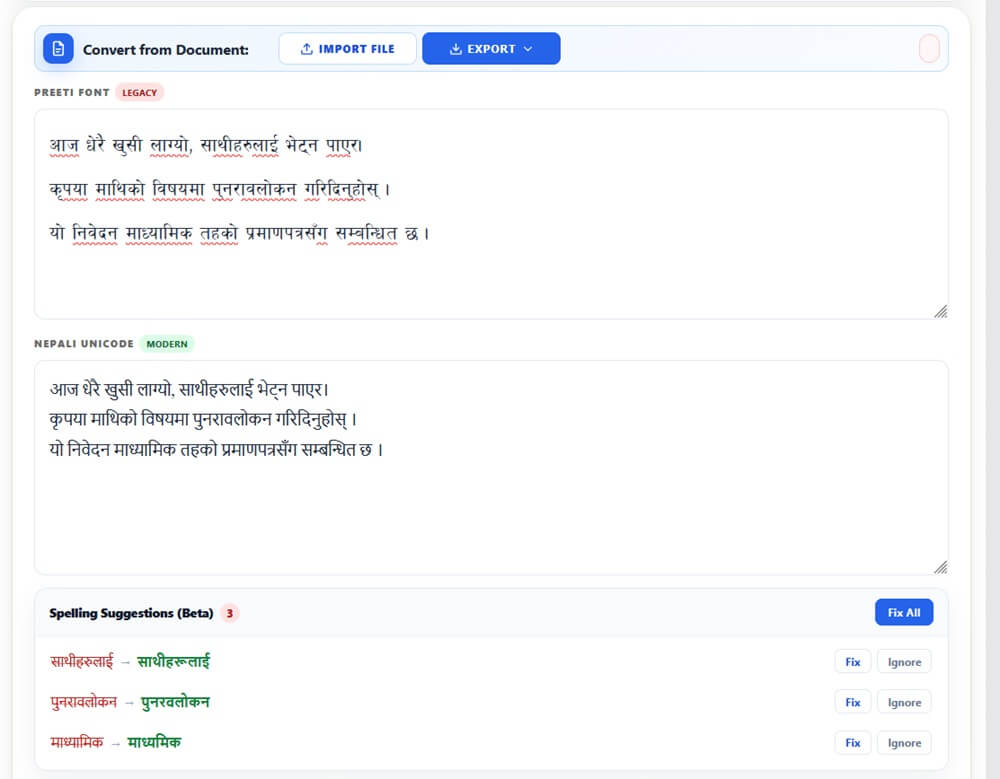
Since this guide was first published, the converter has added an optional Spelling Suggestions (Beta) panel of its own, shown above, which flags a set of commonly confused words, including several covered in this guide, right after conversion, with a one-click Fix or Ignore for each. It's a genuinely useful first pass, but it's explicitly labelled Beta and doesn't claim to catch every category this guide covers, so it's worth treating as a helpful assist rather than a replacement for the proofreading method below.
Important: converting Preeti to Unicode is not the same as spelling correction. It's an encoding change, not a proofreading step.
Open the Converter →This is worth stating plainly, because it's a common and understandable misconception: a Preeti-to-Unicode converter does not fix your Nepali spelling. Conversion and spelling correction are two entirely different problems. Conversion asks "does this character correctly represent what was typed," and answers it faithfully, character for character. Spelling correction asks "was the word itself typed correctly to begin with," which the converter has no way to judge, because it isn't reading for meaning, it's translating an encoding. If a document was typed with incorrect Nepali spelling in Preeti, converting it to Unicode will, entirely correctly, produce a Unicode document with the exact same incorrect spelling. The conversion did its job perfectly; the spelling mistake simply came along for the ride. This is exactly why the proofreading method in the next section is a separate, necessary step after conversion, never a substitute for it.
A Complete Preeti-to-Unicode Workflow
Here's the full, practical sequence for handling an old Preeti document properly, spelling included.
Conversion first, proofreading second. Skipping straight from step 4 to step 7 is the single most common way old Preeti documents end up carrying decades-old spelling mistakes forward into brand-new Unicode files.
Don't Trust Your Eyes: Fonts, Rendering and Encoding
One more honest complication: how a Nepali word visually renders on your screen isn't a perfectly reliable guide to whether it was typed correctly. Devanagari conjuncts are represented in Unicode as a sequence, a consonant, a halant, and another consonant, and it's the font, not the underlying text, that decides how that sequence is drawn on screen. Two different fonts can render the exact same correctly-typed Unicode sequence with slightly different-looking joins, and, more importantly for this guide's purpose, a browser, operating system, or app with an outdated or missing font can render even perfectly correct Unicode text with broken or box-shaped characters. That's a display problem, not a spelling problem, and it's easy to confuse the two, especially with older text that was never fully converted from Preeti in the first place. When something looks wrong on screen, it's worth checking whether the text itself is wrong or whether it's simply a rendering issue on that particular device.
Nepali Typing Context
How you're typing shapes the kind of mistake you're likely to make, which is worth knowing before you proofread.
Traditional Unicode Typing
A layout resembling the old Preeti key positions, but producing real Unicode. Mistakes here tend to be halant and conjunct-formation errors, since the keystroke sequence still matters.
Romanized (Phonetic) Unicode
Type the word as it sounds in English letters; a tool converts it. Vowel-length and स/श/ष-style errors are the most common, since the input doesn't force you to choose the correct letter directly.
Mobile Typing and Autocorrect
Small keys and aggressive autocorrect introduce mistakes that have nothing to do with knowing the word, purely mechanical mistyping and unwanted "corrections."
Copy-Paste Artifacts
Text copied from a PDF, an old Preeti document, or a poorly-encoded webpage can carry invisible formatting or leftover encoding issues that look like spelling mistakes but are really transfer artifacts.
Whichever method you're typing with, the same underlying set of Merokalam tools covers the full workflow: Nepali Keyboard for layout-based typing, Easy Nepali Typing for Romanized input, and Typeshala for building typing speed and accuracy through practice.
The 7-Pass Proofreading Method
Trying to catch every category of mistake in one read-through is exactly why so many slip past. Each pass below has one job. It takes longer than reading once, but it catches far more, because your attention is fully on one thing at a time instead of split across seven.
Spelling Checklist
A condensed version of everything above, for a fast final check before you publish or send anything important.
Verified Commonly Misspelled Words
This list is intentionally shorter than the "Top 50" lists you'll find elsewhere. Every entry below traces back to a documented source discussing that exact word or that exact letter-confusion pattern; nothing here was added just to hit a round number. If you're looking for a specific word that isn't listed, the pattern-based sections above will very likely still explain the mistake you're making.
| # | Commonly Misspelled | Preferred Form | Mistake Type |
|---|---|---|---|
| 1 | दीन (for दिन) | दिन | Vowel length |
| 2 | बिर (for वीर) | वीर | Vowel length + ब/व |
| 3 | फुल (for फूल) | फूल | Vowel length |
| 4 | तिन (for तीन) | तीन | Vowel length |
| 5 | महशूल | महसुल | श/स overcorrection |
| 6 | स्टेशन | स्टेसन | श/स overcorrection |
| 7 | रजिष्टर | रजिस्टर | ष/स overcorrection |
| 8 | सेमिष्टर | सेमिस्टर | ष/स overcorrection |
| 9 | होण्डा | होन्डा | ण/न overcorrection |
| 10 | बृज | ब्रिज | ऋ/रि confusion |
| 11 | अनुशरण | अनुसरण | श/स confusion |
| 12 | पुनरावलोकन | पुनरवलोकन | Extra vowel inserted |
| 13 | दुरावस्था | दुरवस्था | Extra vowel inserted |
| 14 | पत्रकारीता | पत्रकारिता | Vowel length in suffix |
| 15 | धैर्यता | धैर्य | Redundant suffix |
| 16 | माध्यामिक | माध्यमिक | Vowel length |
| 17 | मुर्खजी | मुखर्जी | Letter-order error |
| 18 | काठमाण्डौं / काठमान्डु | काठमाडौं | Multiple variants in real use |
| 19 | निति / निती / नीती | नीति | Vowel-length variants |
| 20 | ब्यख्त / बेक्त / वेक्त | व्यक्त | Multiple variants in real use |
Frequently Asked Questions
The most frequent categories are vowel-length errors (इ/ई, उ/ऊ), consonant confusion (न/ण, स/श/ष, ब/व), missing or misplaced halant marks on half-letters, and matra placement errors, especially with the ि vowel sign. Loanwords borrowed from English or Sanskrit-origin words add a second layer of confusion on top of these.
Learn the underlying patterns rather than memorizing individual words: know which letter pairs are commonly confused and why, read slowly with attention to matras and halants, and proofread in dedicated passes rather than trying to catch everything in one read. Regular reading of edited Nepali text, like newspapers or published books, also builds intuition over time.
All three represent similar sounds in spoken Nepali, which is why they get confused in writing. As a general pattern, श and ष appear mainly in words of Sanskrit origin (tatsam words), while native Nepali words and most loanwords from other languages use स. This is a pattern to guide you, not an absolute rule for every word, so checking a dictionary for words you're unsure of is still the reliable method.
ण is a retroflex sound, mostly appearing in Sanskrit-origin (tatsam) words, such as गणित. न is a dental sound used in native Nepali words and in most words borrowed from other languages. Using ण in a loanword, like writing होण्डा instead of होन्डा, is a common overgeneralization of the Sanskrit pattern.
Two reasons. First, some matras represent short and long versions of nearly the same vowel sound, so the ear alone often cannot tell you which one a word needs. Second, the ि matra is written before its consonant but pronounced after it, which is the opposite of how every other matra behaves, and that visual-versus-spoken mismatch causes real typing errors.
A halant, also called a virama, is the small diagonal mark that removes a consonant's built-in vowel sound so it can combine cleanly with the next consonant, forming a half-letter or a conjunct. Leaving it out, or placing it on the wrong consonant, is one of the most common typing-driven spelling mistakes in digital Nepali.
Preeti is a font that maps ordinary keyboard characters to Devanagari-looking shapes visually, without those characters actually being Nepali letters underneath. Unicode assigns each Devanagari character its own real, permanent code point. Converting the two matches the visual meaning to the correct underlying character, which is a different process from checking whether the word itself is spelled correctly.
No. Conversion changes how text is encoded, not whether the word was spelled correctly to begin with. Text that was spelled incorrectly in Preeti will still be spelled incorrectly after it becomes Unicode; the converter faithfully carries the same spelling across, mistakes included. Proofreading is a separate, necessary step after conversion.
Paste your Preeti text, or import a PDF, DOCX, Excel, or TXT file, into a converter such as Merokalam's Preeti to Unicode Converter. It reads the Preeti-encoded characters and outputs the equivalent real Nepali Unicode text, which you can then export and proofread.
No. Preeti is a legacy font-based workaround from before Nepali had proper digital text support. Unicode is the modern, standardized way of representing Nepali characters that works across devices, browsers, and operating systems without needing a specific font installed.
Use dedicated passes rather than one read-through: first for meaning, then specifically for commonly confused consonants, then matras, then conjuncts and halants, then proper names, then punctuation, and finally read the text aloud. Each pass catches errors the others miss because you're focused on one category at a time.
Some word processors and browser extensions offer basic Nepali spell-checking, and Merokalam's own Preeti to Unicode Converter now includes an optional Spelling Suggestions (Beta) panel that flags a set of commonly confused words after conversion. Coverage and accuracy still vary, and no automated tool catches every category of mistake described in this guide. Careful manual proofreading using a structured method, combined with a dictionary check for words you're unsure of, remains the most reliable approach for Nepali.
This is usually a font or encoding mismatch, most often old Preeti-encoded text being viewed without the Preeti font installed, or without first being converted to Unicode. It's a display problem, separate from whether the underlying words are spelled correctly.
Slow down at the letter pairs you already know you confuse. Almost everyone who writes Nepali regularly can name two or three letter pairs that trip them up; checking specifically for those in a dedicated proofreading pass catches more mistakes than trying to read carefully in general.