How to Practice Preeti Typing With Typeshala
Learning Preeti typing is mainly about building keyboard memory. Instead of hunting for each Nepali character every time, start with a small group of keys, practise them until they're accurate, combine them into common words, and only then work on speed. This guide walks through that path using Typeshala's real Preeti lessons, from your first key press through matras, half forms, sentences and timed practice.
This guide is specifically about learning Preeti with Typeshala. If you want a broader tour of the whole tool, including Unicode and English modes, timed tests and how the stats work, see How to Use Typeshala Online instead. That guide explains the tool; this one is the Preeti course.
What's Your Current Preeti Level?
What Is Preeti?
Preeti is a traditional Nepali font-based keyboard layout. It's still common in older Word files, government office documents, publishing workflows and some typing-practice environments. In Preeti mode, you're not typing phonetically the way you would with a Romanized system; you're learning which physical key produces which Devanagari character, the same way an English touch typist learns that the F and J keys sit under the index fingers without thinking about it.
That's also why Preeti feels harder at first than Unicode. There's no shortcut where the key "sounds like" the letter it produces. The upside is that once the key positions are in your fingers, Preeti typing gets genuinely fast, because you stop translating sounds in your head altogether.
Ready? Start Preeti Lesson 1 →
Understanding the Preeti Keyboard
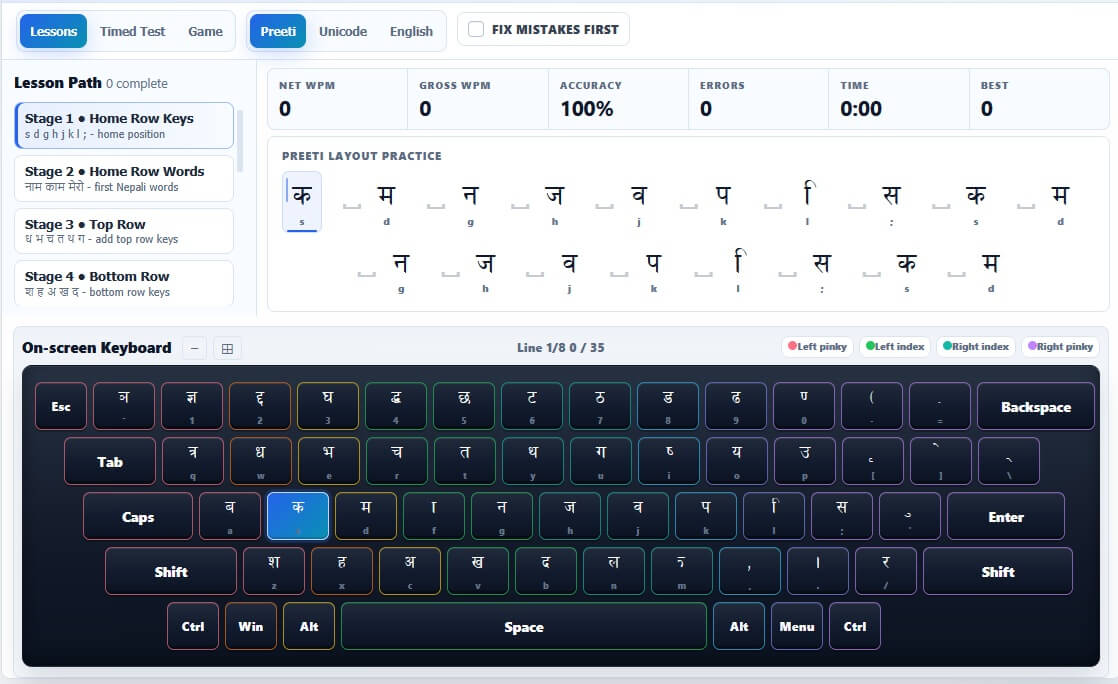
Below is a verified reference built from Typeshala's own Preeti key data, covering the keys a learner actually meets across the early lesson stages: home row, top row and bottom row. Each key shows the Devanagari character it produces and the physical English key underneath.
This reference maps exactly the keys used in Typeshala's own Preeti lesson data. It covers the letters a beginner meets through Stage 4; matras and half forms are covered separately below. Finger zones follow standard touch-typing column assignment.
How Typeshala Teaches Preeti
Typeshala's Preeti track runs through 10 stages, and the order matters more than it looks. Early stages isolate one small group of keys at a time; later stages combine rows, then add matras, half forms and finally full sentences. Here's what each stage actually asks you to practise.
| Stage | Focus | What you're building |
|---|---|---|
| 1 | Home Row Keys | Finger memory for s d g h j k l ; |
| 2 | Home Row Words | First real Nepali words: नाम, काम, मेरो |
| 3 | Top Row | ध भ च त थ ग added to the mix |
| 4 | Bottom Row | श ह अ ख द and full-keyboard reach |
| 5 | Vowel Marks | का कि कु के को की matra accuracy |
| 6 | Half Forms | क् न् ज् त् म् halant combinations |
| 7 | Short Sentences | Full Preeti sentences with punctuation |
| 8 | Common Sentences | Everyday sentence patterns |
| 9 | Lok Sewa Short | Short, formal exam-style sentences |
| 10 | Advanced | Longer, mixed-difficulty lines for timed-test readiness |
Don't treat this like a checklist to clear in one sitting. Stage 1 and 2 are where finger memory actually forms. If those feel shaky, every later stage feels harder than it needs to. Repeat a stage until the mistakes get boring, then move on.
Finger Position for Faster Preeti Typing
The keyboard reference above is colour-coded by finger zone using the standard touch-typing column layout: left pinky and ring cover the far-left keys, left index and middle cover the centre-left, right index and middle cover the centre-right, and right ring and pinky cover the far-right keys, with both thumbs on the space bar. This has nothing to do with Preeti specifically; it's the same finger assignment used for any QWERTY layout, applied to the Preeti keys sitting on top of it.
The goal isn't to memorise a finger chart forever, it's to build muscle memory so your hands return to the same resting position after every key press. A practical progression that works for most beginners:
Step 1: Practice Preeti Characters
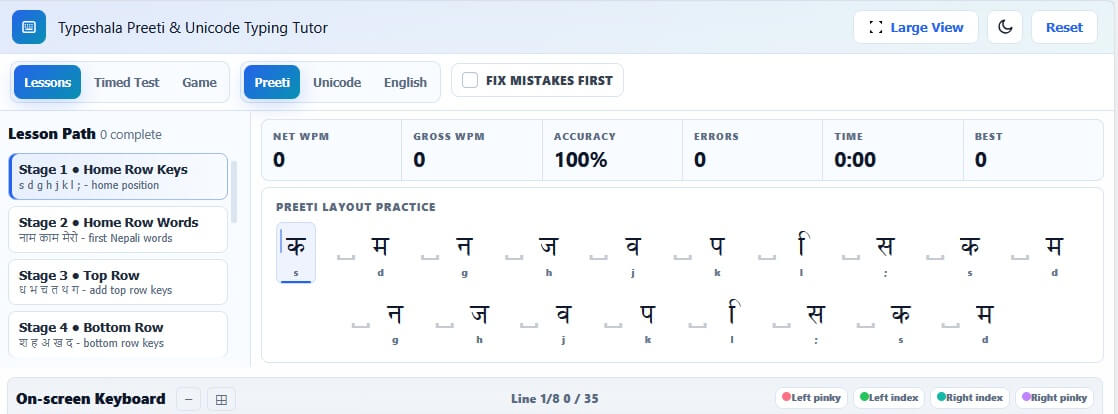
Start with the home row, since it's where your fingers already rest: s d g h j k l ; produce क म न ज व त ि स. Don't try to learn the whole keyboard in one sitting; Typeshala's own Stage 1 isolates exactly this group for a reason.
Practice for 2 minutes: cycle through s, d, g, h, j, k, l, ; slowly and accurately, resetting your fingers to the home row between each one.
Continue Character Practice in Typeshala →
Step 2: Practice Common Words in Preeti
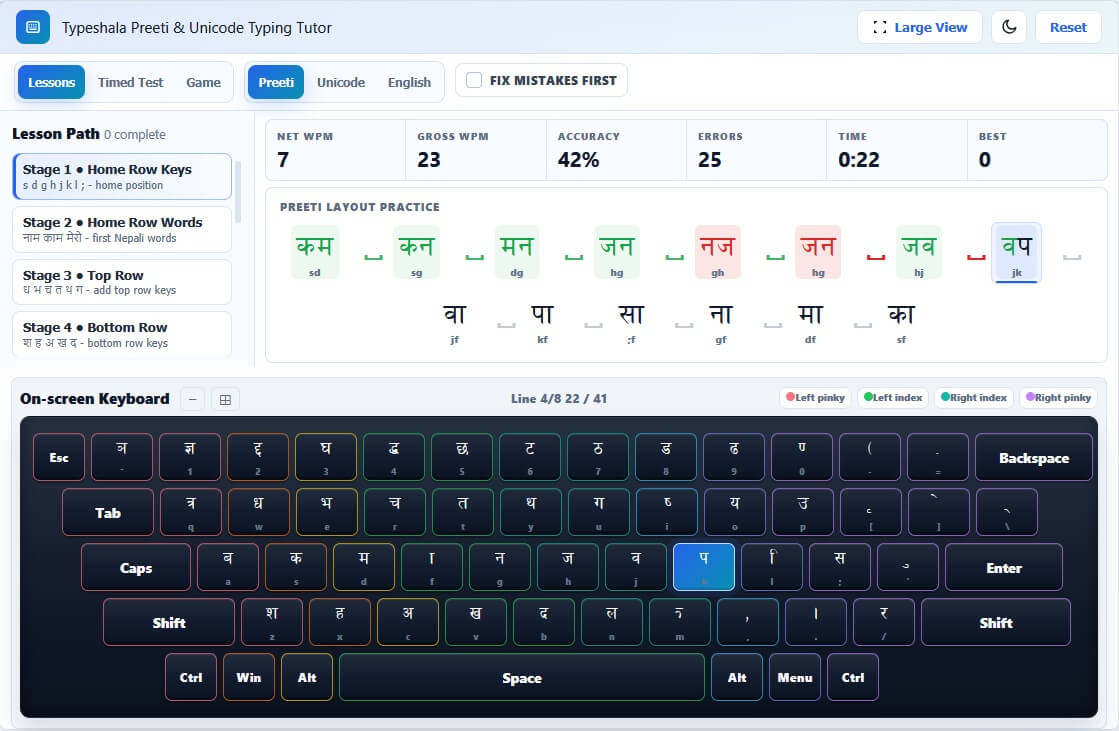
Once single keys stop feeling random, move to short words built from the same home-row keys. Typeshala's own Stage 2 uses exactly this approach, starting with नाम (name), काम (work) and मेरो (mine), then adding a few more home-row combinations. The point isn't to memorise this exact list, it's to feel your fingers move between keys instead of resetting after every single letter.
| Word | Meaning | Keys used |
|---|---|---|
| नाम | name | g, f, d |
| काम | work | s, f, d |
| मेरो | mine | d, ], /, J |
Practice More Words in Typeshala →
How to Practice Nepali Matras in Preeti
Matras (vowel marks) are where most beginners stall, because the key you press doesn't visually match where the mark lands on the letter. Typeshala's Stage 5 is built specifically around this using the six most common forms:
| Matra | Result on क | Key |
|---|---|---|
| ा (aa) | का | f |
| ि (i) | कि | l |
| ु (u) | कु | ' |
| े (e) | के | ] |
| ो (o) | को | Shift + J |
| ी (ii) | की | Shift + L |
Practice one matra at a time against a consonant you already know, rather than jumping between all six. Once का कि कु के को की feel automatic, the same matra keys apply to every other consonant on the keyboard.
Practice Matras in Typeshala →
Preeti Joint Letter Typing Practice
Joint letters (sanyukta akshar) like क्ष, त्र, ज्ञ, श्र and प्र show up constantly in real Nepali text, and Typeshala's Stage 6 is built around the halant forms that make them possible: क् न् ज् त् म्, each typed with Shift plus the base key. This guide keeps that part brief on purpose, since the full breakdown of how each conjunct is actually built deserves its own space.
Need the full guide? Learn Nepali Joint Letters →
Step 3: Preeti Sentence Typing Practice
Sentences are where accuracy, matras and half forms come together at once, which is exactly why they sit at Stage 7 and later, not Stage 1. Typeshala's sentence stages start short and formal, close to the kind of writing you'd actually produce in an office or exam setting, then gradually get longer through Stage 8, 9 and 10.
Don't try to build a large sentence library here; that's what the structured lesson stages are for. The habit that actually matters is typing a full sentence, including the punctuation, without stopping to fix every small mistake mid-line.
Accuracy Comes Before Speed
This isn't SEO advice, it's the actual order Typeshala's own lesson path enforces: key recognition, then accuracy, then words, then sentences, then speed, then timed tests. Skipping straight to speed just trains bad finger paths that are harder to unlearn later than they were to avoid in the first place.
What Is a Good Preeti Typing WPM?
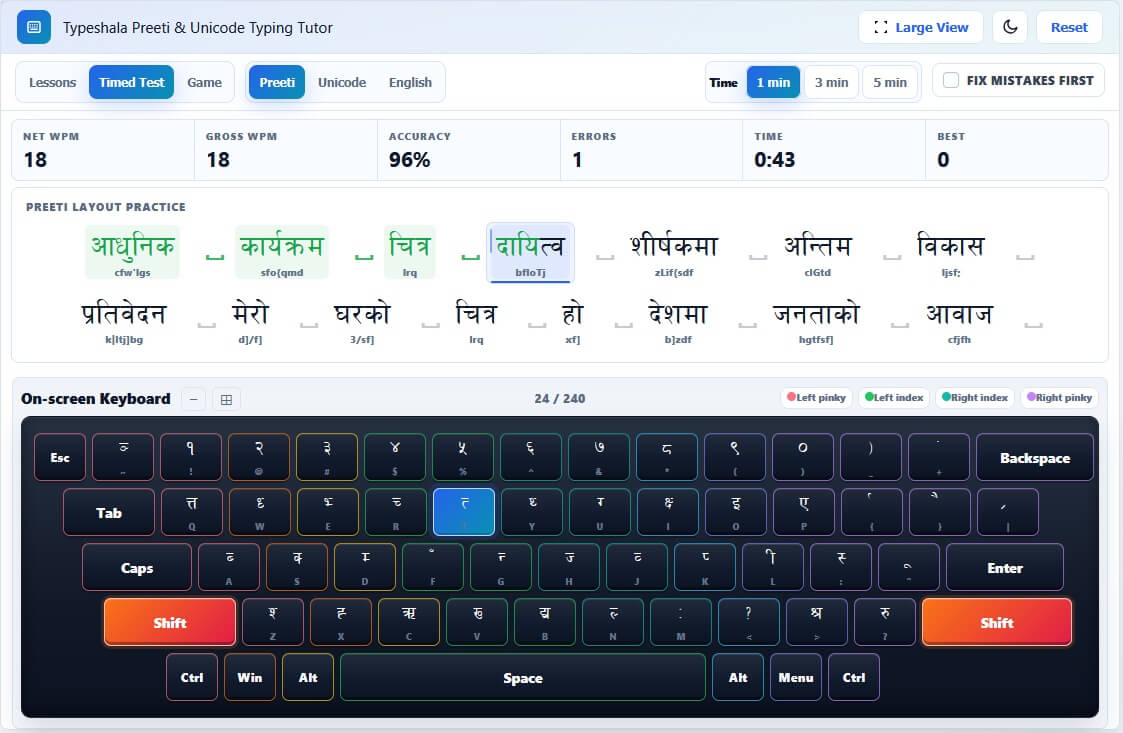
Typeshala shows Gross WPM, Net WPM and Accuracy live as you type. Gross WPM is typed keystrokes divided by 5, divided by minutes; Net WPM subtracts uncorrected errors per minute, which makes it the more honest number. By Merokalam's own practice bands from inside the tool:
| Net WPM | Level |
|---|---|
| Under 10 | Learning |
| 10–19 | Beginner |
| 20–29 | Basic use |
| 30–39 | Functional practice |
| 40+ | Comfortable to advanced |
These are Merokalam practice benchmarks, not universal employment or examination requirements. If a specific job or exam states its own typing requirement, treat that number as the one that matters.
If your Preeti speed has already stalled at a specific number for a while, the general accuracy-then-speed advice on this page will only get you so far. How to Increase Nepali Typing Speed in Preeti covers that plateau specifically, so this guide stays focused on learning the layout rather than repeating that whole topic here.
Short Preeti Practice Routines
5-Minute Daily Preeti Practice
Start Today's Preeti Practice →
15-Minute Routine for Serious Learners
Learn Preeti Typing in 30 Days
This is a 30-day practice plan, not a promise of mastery in 30 days. Speed and comfort keep improving well beyond this, but by the end of Week 4 most learners have stopped looking at the physical keyboard for anything but half forms.
My Preeti Learning Progress
Checks are saved in your browser only, the same way Typeshala saves your practice progress.
Should You Learn Preeti or Unicode?
Preeti and Unicode both produce Nepali text, but they solve different problems: Preeti is tied to a specific font and legacy key mappings, while Unicode is a text standard that displays correctly across modern browsers and devices without any special font. Preeti isn't useless, and the two aren't simply "two fonts", they're different systems with different tooling built around them.
If your goal is specifically learning and practising Preeti, you're in the right place. If you're not sure Preeti is even what you need, How to Use Typeshala Online covers choosing between Preeti, Unicode and English before you commit to a lesson path.
Do You Need the Preeti Font?
Typeshala teaches you the Preeti keyboard, entirely inside the browser. That's a separate thing from having the Preeti font installed on your computer, which you only need if you're opening, editing or printing existing Preeti-based documents outside the tool.
Download & Install Preeti Font →
What If You Already Have a Preeti Document?
Learning Preeti and converting existing Preeti text are two different tasks. If your goal is to learn the keyboard, stay here and keep practising in Typeshala. If you already have Preeti-based text that needs to work as modern Unicode, that's a conversion job, not a typing job.
Which Preeti Tool Do You Need?
| Goal | Merokalam resource |
|---|---|
| Learn Preeti | Typeshala |
| Practice Preeti | Typeshala |
| Test Preeti WPM | Typeshala |
| Improve Preeti speed | Preeti Speed Guide |
| Practice more words and sentences | Beginner Practice Roadmap |
| Download Preeti font | Preeti Font Download |
| Convert Preeti text | Preeti to Unicode |
| Learn joint letters | Joint Letter Guide |
| Need modern web typing instead | Easy Nepali Typing |
If your real goal is just writing a paragraph of Nepali right now, without learning a keyboard, Easy Nepali Typing gets you there with Romanized input and no lesson path. Come back here when the goal is keyboard skill, not just output.
Is Preeti Typing Useful for Office Jobs?
In offices still running legacy Preeti-based workflows and document templates, yes, Preeti knowledge remains genuinely useful. Many modern office roles have moved to Unicode instead, so it's worth confirming which layout a specific job actually expects before assuming Preeti alone is enough.
Read: Nepali Typing for Office Jobs, Preeti, Unicode & WPM Skills →
Can I Practice Preeti for Lok Sewa With Typeshala?
Typeshala can help develop typing familiarity, speed, accuracy and timed-test habits, all genuinely useful for Lok Sewa preparation. Exact requirements vary by examination and post, so treat this as practice infrastructure, not an official standard.
This is an independent practice tool and is not an official Lok Sewa Aayog website or examination platform. Confirm current requirements from the relevant vacancy or examination notice.
Lok Sewa Computer Operator Typing Guide →
Common Preeti Typing Problems
The Preeti font usually isn't installed or active on that device or application. Preeti relies on a specific font mapping, so without it, the underlying characters display as plain English instead of Devanagari.
Preeti is a legacy, font-dependent encoding, not Unicode. Pasting it somewhere without the Preeti font active will show garbled or English-looking text. Convert it first if it needs to work outside a Preeti-only environment.
Double-check you're in Preeti mode, not Unicode or English, since each layout maps the same physical keys differently.
Learn in small groups rather than all at once, home row, then top row, then bottom row, and repeat each group until it stops feeling random before adding the next.
Check whether accuracy is the real bottleneck first. A high Gross WPM next to a much lower Net WPM usually means the fix is fewer mistakes, not faster fingers.
This is normal early on. Slow back down deliberately for a few sessions; consistent accuracy at a lower speed converts into real speed faster than pushing through mistakes.
How This Guide Was Verified
Every keyboard mapping, lesson stage name and formula on this page was checked directly against Typeshala's own Preeti data and tested live in the tool, not guessed from a general knowledge of old Nepali keyboards. The timed-test result shown above is a real capture from that testing session.
Keep Practising
More Preeti & Nepali Typing Resources
Once the basics feel comfortable, these cover the parts this guide deliberately kept short.
This guide focuses specifically on learning Preeti with Typeshala. Practice benchmarks reflect Typeshala's own internal tracking, not universal employment, exam or Lok Sewa Aayog standards; always confirm official requirements from the relevant notice.
Frequently Asked Questions
Ready to Practice Instead of Reading?
If you understand the basic idea of Preeti now, the next step is repetition, not more reading. Start with the beginner lesson, focus on hitting the correct keys, and only move to timed practice once your accuracy becomes consistent.
Start Preeti Typing in Typeshala →
Already know Preeti? Take a timed test instead →